Salkantay Mountain is one of the most impressive snow-capped peaks in southern Peru and one of the most representative summits in the Cusco region. Its presence dominates the Andean landscape with glaciers, deep ravines, and a natural setting where elevation, climate, and culture come together powerfully.
Beyond its geographical importance, Salkantay holds a special place in Andean cultural memory. For many local communities, this peak represents protection, strength, and connection with nature. In this guide, you’ll learn exactly what Salkantay Mountain is, where it is located, how high it is, why it is considered sacred, and what you should know before approaching its surroundings.
Table of contents
- What Is Salkantay Mountain in Peru?
- Where Is Salkantay Mountain Located? Map and Geography
- Elevation and Geography of Salkantay Mountain
- Why Is Salkantay a Sacred Mountain in Andean Culture?
- Can You Visit Salkantay Mountain Without Doing the Full Trek?
- What Is the Weather Like on Salkantay Mountain?
- Is Salkantay Mountain Dangerous?
- What You Really Experience Near Salkantay Mountain
- How to Discover Salkantay Mountain Up Close
- Can You Climb Salkantay Mountain?
- Is Salkantay Mountain Worth Visiting?
- Common Mistakes When Searching for Salkantay Mountain in Peru
- Frequently Asked Questions About Salkantay Mountain in Peru
- Discover Salkantay Mountain and Explore the Route to Machu Picchu
What Is Salkantay Mountain in Peru?
Salkantay Mountain is a snow-capped peak located in the Vilcabamba Mountain Range, in the Cusco region of Peru. It reaches approximately 6,271 m / 20,574 ft, making it the highest summit in the Vilcabamba range and one of the most iconic mountains in the southern Peruvian Andes.
It is known for its glaciers, scenic beauty, high-altitude environment, and spiritual importance as Apu Salkantay, a sacred mountain within the Andean worldview.
Quick Facts About Salkantay Mountain
| Fact | Information |
|---|---|
| Name | Salkantay Mountain / Apu Salkantay |
| Location | Vilcabamba Mountain Range, Cusco, Peru |
| Elevation | 6,271 m / 20,574 ft |
| Type | Andean snow-capped mountain |
| Importance | Sacred summit and natural symbol of Cusco |
| Nearby landscapes | Glaciers, lagoons, high-Andean valleys, and cloud forests |
| Best nearby areas | Soraypampa, Humantay Lake, and the valleys of the Salkantay corridor |
| Is it a trek? | No. It is a mountain; the Salkantay Trek is a route that allows you to get close to its surroundings |
Salkantay Mountain vs. Salkantay Trek: Quick Difference
It is important not to confuse the mountain with the trekking route.
- Salkantay Mountain: this is the snow-capped peak, the sacred summit, and the main geographical feature.
- Salkantay Trek: this is a hiking route that allows you to get close to the surroundings of the snow-capped mountain and continue toward the Inca citadel of Machu Picchu.
This difference is key because many people search for information about the mountain but end up finding details about the route. In this article, we focus mainly on Salkantay Mountain: its location, elevation, geography, cultural value, and natural surroundings.
Where Is Salkantay Mountain Located? Map and Geography
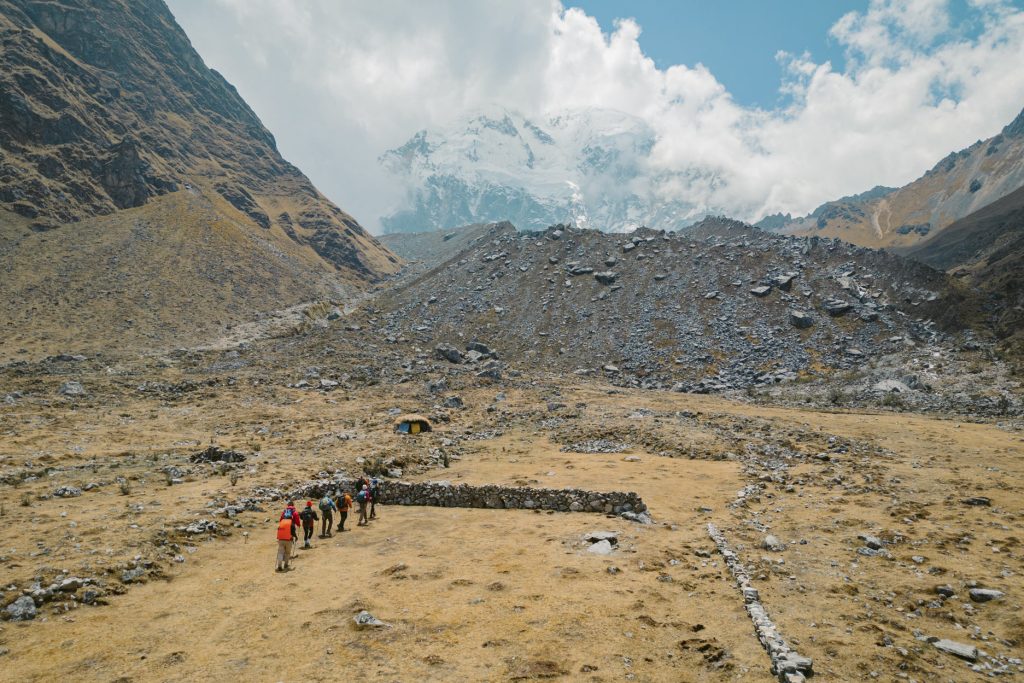
Salkantay Mountain is located in the Vilcabamba Mountain Range, in the Cusco region, in southern Peru. This mountain range is part of the Peruvian Andes and brings together some of the most impressive landscapes in the area: snow-capped peaks, high-Andean lagoons, ravines, deep valleys, and ecosystems that descend toward more humid and greener zones.
Its location makes it one of the most representative mountains in Cusco’s natural surroundings. Although many people associate it with adventure routes, Salkantay is, above all, a sacred and geographically important summit within the Andean landscape.
Location in the Peruvian Andes
Salkantay is located in the southern Peruvian Andes, in the Vilcabamba Mountain Range. This area stands out for its rugged terrain, snow-covered slopes, and proximity to other important natural places, such as Humantay Lake and the valleys that connect with Machu Picchu.
To better understand its location:
- Country: Peru
- Region: Cusco
- Mountain range: Vilcabamba
- Type of environment: high-altitude Andean zone
- Nearby landscapes: glaciers, lagoons, ravines, valleys, and cloud forests
This location explains why Salkantay has such variable conditions and such a powerful visual presence: it rises over an area where the Andes begin to transform into more humid and greener ecosystems.
Distance from Cusco
Salkantay Mountain is located northwest of the city of Cusco; geographically, it is about 60 km (37.3 miles) from Cusco, within the Andean corridor that connects Mollepata, Challacancha, Soraypampa, and the Vilcabamba Mountain Range.
In terms of tourist access, the most common route from Cusco to Soraypampa—one of the base points for starting the hike—is approximately 110 to 115 km (68 to 71 miles) by road and usually takes between 2.5 and 3.5 hours by vehicle, depending on road conditions, weather, and stops along the way.
From there, the approach to the Salkantay area continues along mountain trails. For example, the section between Soraypampa and Salkantaypampa may be around 7 km (4.35 miles), while the route to the Salkantay Pass involves several hours of high-altitude hiking, depending on the group’s pace and trail conditions.
That is why, when someone searches for where Salkantay Mountain is located, the answer should not be limited to a number of kilometers. Although it is relatively close to Cusco in regional terms, it belongs to a high-mountain environment where access requires planning, proper acclimatization, and respect for the natural conditions of the Andes.
Elevation and Geography of Salkantay Mountain
Salkantay Mountain reaches approximately 6,271 m / 20,574 ft above sea level. This elevation makes it one of the highest and most recognized summits in the Cusco region, as well as the main peak of the Vilcabamba Mountain Range.
Geographically, Salkantay is not just a snow-capped summit. It is part of a mountain system where climate, elevation, and terrain create an intense natural setting: cold areas, steep slopes, glacial formations, ravines, and valleys that descend toward more temperate environments.
Elevation in Meters and Feet
Salkantay’s elevation is one of the most searched facts by travelers, especially because it helps them understand the true magnitude of this mountain.
- Elevation of Salkantay Mountain: 6,271 m / 20,574 ft
- Type of mountain: Andean snow-capped mountain
- Mountain range: Vilcabamba
- Region: Cusco, Peru
- Importance: highest summit in the Vilcabamba Mountain Range
- Environment: cold climate, variable conditions, and high exposure to altitude
This elevation places it far above the city of Cusco and Machu Picchu. That is why, when talking about Salkantay’s elevation, it is not just about a number: it refers to a mountainous territory where oxygen decreases, temperatures change quickly, and the landscape becomes more demanding.
Glaciers and Nearby Mountains
Salkantay is part of a landscape dominated by ice, rock, snow, and nearby mountains that complete the visual strength of the Vilcabamba Mountain Range. Its glaciers feed ravines and high-altitude ecosystems, and they also explain why this summit has been seen for centuries as a source of life for Andean communities.
Around the snow-capped mountain, you can find:
- High-Andean glaciers that cover part of its slopes.
- Deep ravines formed by the relief of the mountain range.
- Glacial lagoons, characteristic of this area of Cusco.
- Transitional valleys, where the landscape changes from cold zones to greener areas.
- Nearby mountains that reinforce the geographical importance of Vilcabamba.
This combination of elevation, ice, rock, and valleys makes Salkantay much more than a famous mountain: it is a key point within the natural system of the Peruvian Andes and one of the most powerful images of the Cusco landscape.
Why Is Salkantay a Sacred Mountain in Andean Culture?
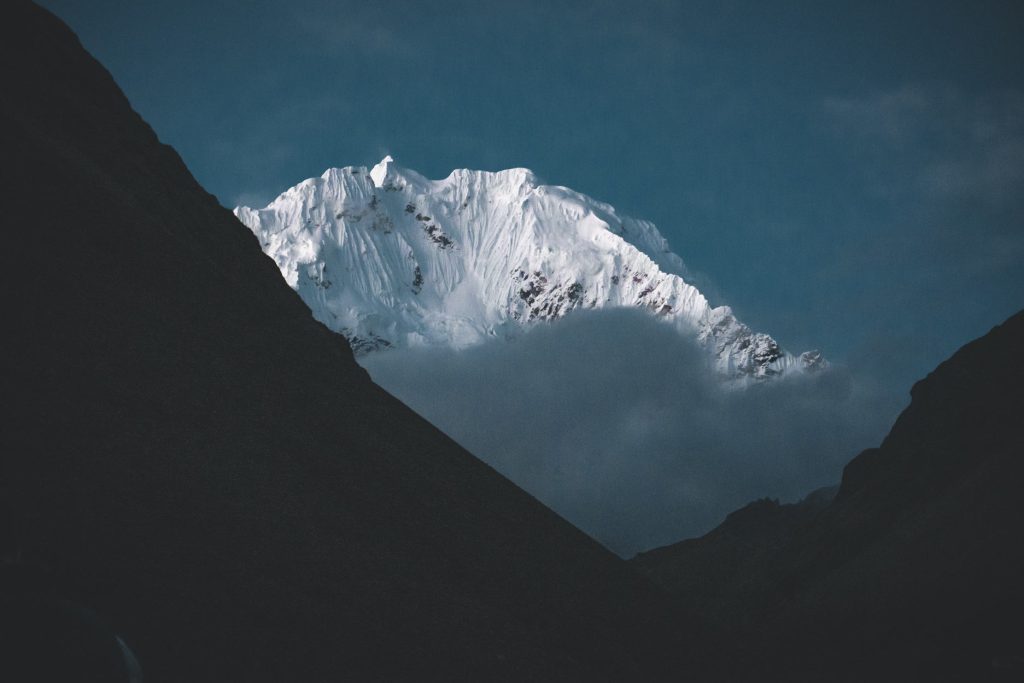
Salkantay does not stand out only because of its elevation and glacial landscape. Within the Andean worldview, it is also an Apu, meaning a sacred mountain with a spiritual and protective presence. In many communities throughout the Andes, the Apus are seen as guardians of the territory, the climate, the crops, and the life that begins in the valleys.
In the case of Salkantay, its imposing image, snow-capped summit, and location within the Vilcabamba Mountain Range have strengthened its symbolic value for centuries. Within Andean tradition, it is associated with protection, fertility, natural balance, and respect for the earth.
The Meaning of Apu Salkantay
The word Apu comes from Quechua and is commonly translated as “lord” or “authority.” Within Andean tradition, this term is used to refer to a mountain with deep spiritual value, territorial presence, and influence over the communities settled around it.
For this reason, referring to Apu Salkantay means much more than naming a snow-capped mountain. It means recognizing a protective mountain, respected for its natural strength and for its role within the balance of the Andean world.
From this cultural perspective, mountains are not seen as passive elements of the landscape, but as protective presences that guard, observe, and sustain life in the nearby valleys.
As for its name, Salkantay is often interpreted as “wild mountain” or “untamed mountain.” Some interpretations connect it with the Quechua word sallqa, associated with what is wild or untamed. This reading fits the powerful image of the snow-capped peak: a high, cold, changing summit that is difficult to dominate.
Spiritual Connection with Nature
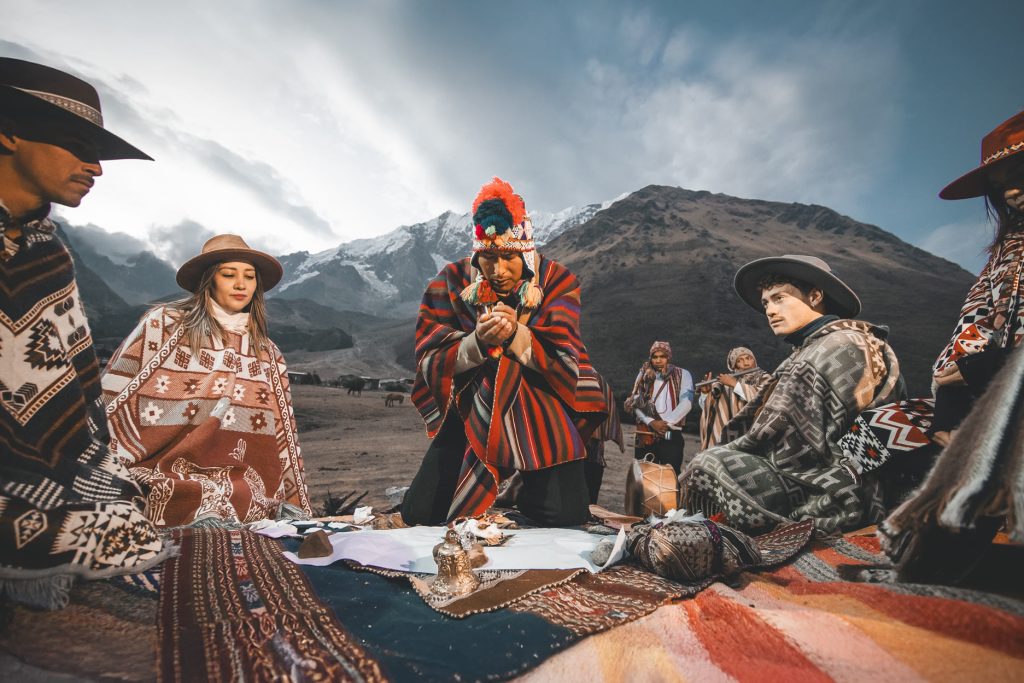
The spiritual connection with Salkantay comes from a different way of understanding nature. In the Andean worldview, the mountain, water, earth, animals, and people are all part of the same web of life. For that reason, respect for the Apu is not only a religious belief, but a relationship of reciprocity with the environment.
To this day, offerings are made in different Andean areas—such as coca leaves (k’intu), chicha de jora, seeds, sweets, colored wool, and symbolic elements—along with gestures of gratitude to the mountains. These practices seek to ask for permission, protection, and balance before entering territories considered sacred.
This spiritual dimension makes Salkantay a deeply meaningful mountain for the culture of Cusco. Its value lies not only in its height or scenic beauty, but in what it represents: a living presence within the Andean world, a symbol of strength, respect, and connection with nature.
Can You Visit Salkantay Mountain Without Doing the Full Trek?
Yes, you can get close to the Salkantay Mountain area without doing the full trek to Machu Picchu. However, it is important to understand something: Salkantay is a high-altitude snow-capped mountain, not an urban viewpoint or a directly accessible attraction.
This means it is not “visited” like a plaza, a museum, or an archaeological site. It is observed from routes, valleys, lagoons, and nearby natural viewpoints.
The most common way to appreciate its landscape without completing a multi-day hike is to visit areas such as Soraypampa or Humantay Lake, from where you can see snow-capped mountains, glaciers, and part of the natural surroundings associated with Salkantay.
What You Can See Without Doing the Full Trek
Without doing the full Salkantay Trek, you can mainly see the scenic surroundings of the snow-capped mountain, though not necessarily its summit from every angle. Visibility depends on the weather, cloud cover, access route, and the exact point where you are standing.
On a short or less demanding visit, you can appreciate:
- Nearby snow-capped peaks and glaciers such as Humantay, especially on clear days.
- High-Andean valleys with open landscapes such as Mollepata, mountains, and grazing areas.
- Humantay Lake, one of the most visited natural settings near the Salkantay area.
- Soraypampa, a common access point for short hikes to the lake.
- High-altitude landscapes, characterized by cold, wind, and sudden weather changes.
That said, even if you do not do the full trek, many visits to this area include short or moderate hikes. One of the most accessible options is a one-day excursion to Humantay Lake, located at over 4,200 m / 13,780 ft. Although it is a short outing, the altitude can still be felt, so it is best to go well acclimatized.

Best Places to See the Salkantay Surroundings
The best places to appreciate the surroundings of Salkantay Mountain without doing a long route are those that allow you to observe the high-altitude landscape from accessible areas within the Mollepata and Soraypampa zone.
Humantay Lake
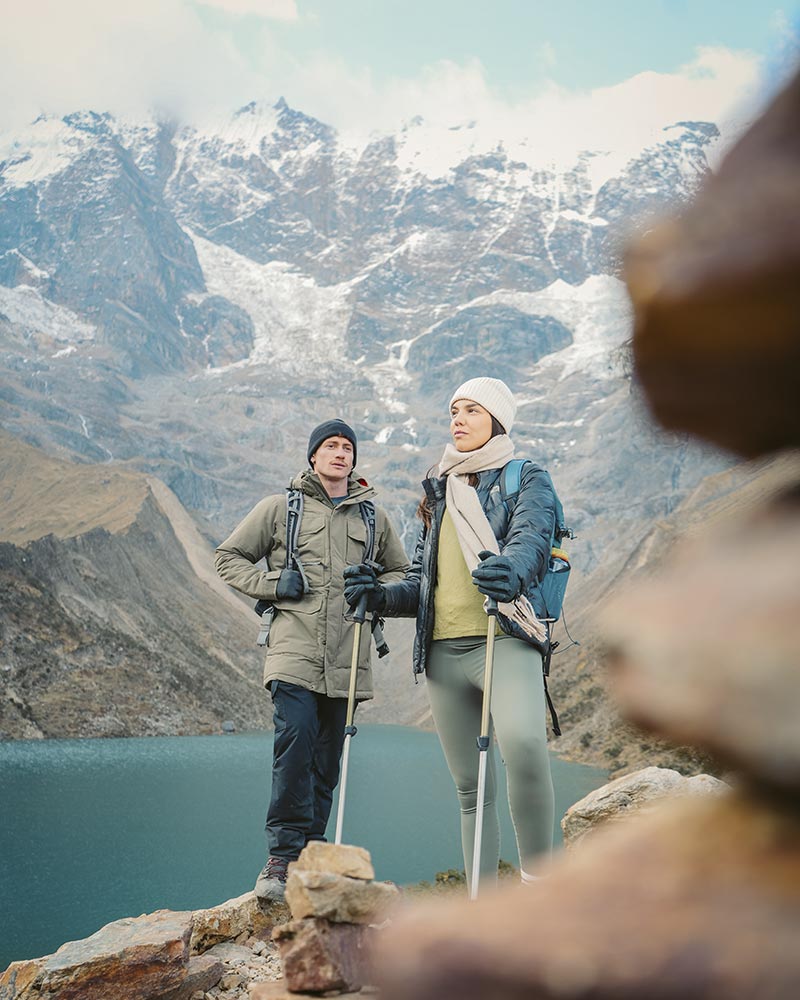
Humantay Lake is one of the best-known natural viewpoints in the area. Its turquoise waters, glacial backdrop, and the presence of snow-capped mountains make it one of the best options for those who want to get close to the Salkantay landscape without doing a multi-day hike.
The route to Humantay usually begins in Soraypampa and allows you to observe part of the area’s glacial environment.
Soraypampa
Soraypampa is a high-Andean area located within the natural corridor toward Salkantay. From here, you can appreciate open landscapes, snow-capped mountains, and high-altitude valleys. It also serves as a starting point for short routes to Humantay Lake or for experiences connected to the mountain range.
Valleys Near Salkantay
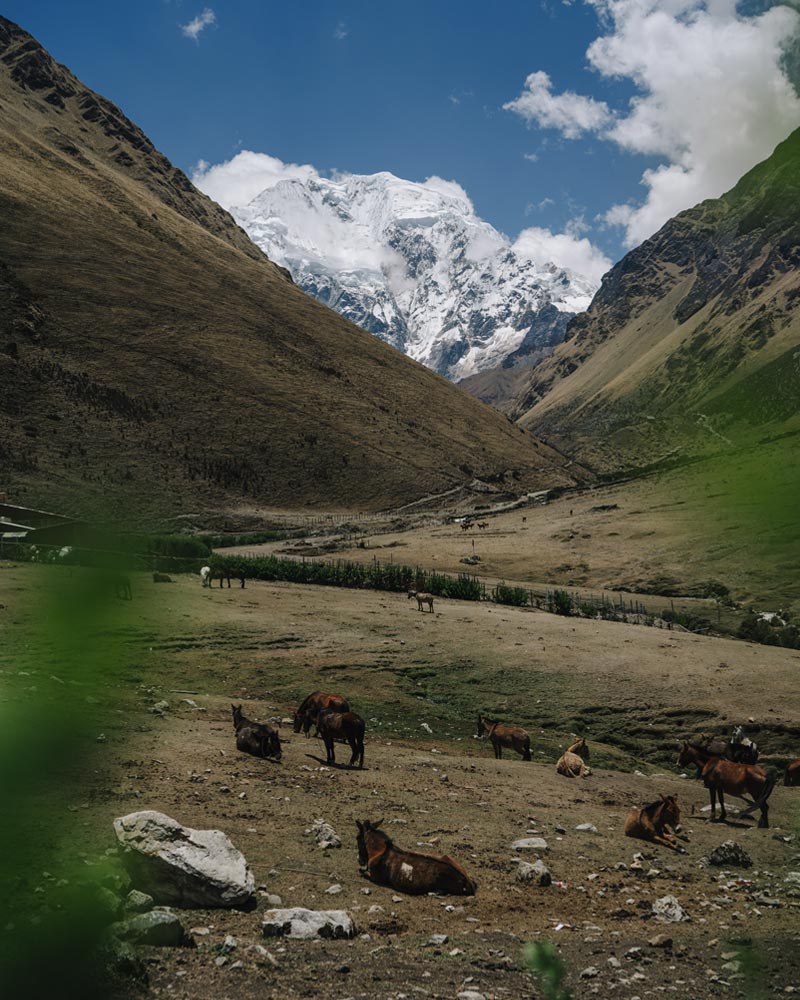
The valleys surrounding the mountain allow you to see the transition between cold high-altitude zones and greener landscapes. This natural variety is one of the reasons why Salkantay stands out within the Peruvian Andes: it is not just a snow-capped summit, but part of a system of landscapes connected by water, ice, ravines, and mountains.
In summary: yes, you can visit areas near Salkantay without doing the full trek, especially Humantay and Soraypampa. However, if you want to see the mountain more closely and understand its true scale, you will need to do a high-altitude hike or a guided route adapted to your time, physical condition, and level of acclimatization.
What Is the Weather Like on Salkantay Mountain?
The weather on Salkantay Mountain is cold, variable, and typical of a high-Andean environment. Due to its elevation, conditions can change quickly between intense sun, wind, cloud cover, rain, or even snow in the highest areas.
For that reason, it should not be understood as a stable climate, but as a mountain environment where altitude directly influences temperature, visibility, and the perceived temperature.
In general terms, the Cusco region has two marked seasons: the dry season, from May to October, and the rainy season, from November to March, with possible rainfall extending into April.
Dry Season and Rainy Season
During the dry season, views of the snow-capped mountains are usually clearer, especially in the mornings. This is the time with less rainfall in Cusco, although in high-altitude areas, conditions can change unexpectedly.
The days can be sunny, but the nights and early mornings are cold, especially near glaciers, high passes, and exposed valleys.
During the rainy season, the landscape becomes greener and the mountains may appear covered by clouds during part of the day. However, rainfall, fog, and wet terrain can reduce visibility and make the experience less predictable.
In summary:
- Dry season: better views, clearer skies, and less rainfall.
- Rainy season: greener landscapes, more cloud cover, and higher humidity.
- Year-round: possibility of cold, wind, and sudden weather changes.
Temperature at High Altitude
The higher the altitude, the lower the temperature and oxygen pressure. In the case of Salkantay, the summit reaches approximately 6,271 m / 20,574 ft, so high-altitude conditions are much colder than in the city of Cusco or in the nearby valleys.
Cusco may have mild days during the dry season, but in areas near glaciers or high passes, the perceived temperature can be much lower due to the wind, intense solar radiation, and exposed terrain.
The temperature on Salkantay Mountain is variable, ranging from 15 °C (59 °F) during the day to -10 °C (14 °F) at night in the highest areas, such as the Salkantay Pass.
For that reason, the weather near Salkantay should be treated as mountain weather, not as urban or valley weather.

Is Salkantay Mountain Dangerous?
Salkantay Mountain should not be seen as a dangerous place in itself, but rather as a demanding natural environment that requires respect. Its elevation, variable conditions, presence of ice, slopes, and isolation mean that any nearby visit should be approached with preparation, especially if the traveler is not used to high altitude.
It is not a dangerous destination when visited with proper information, acclimatization, and good judgment. But it can become risky if the altitude, cold, or sudden weather changes are underestimated.
Altitude-Related Risks
The most common risk in areas near Salkantay is altitude sickness, also known as soroche. It can appear when a person ascends too quickly to high-altitude areas and their body does not have enough time to adapt to the lower availability of oxygen.
The most common symptoms may include:
- Headache.
- Nausea or loss of appetite.
- Unusual tiredness.
- Dizziness.
- Difficulty sleeping.
- Shortness of breath during physical effort.
For that reason, even if someone is not going to do a long trek, they should take the altitude seriously. Cusco is located at 3,400 m / 11,155 ft, and the Salkantay area belongs to a much higher, colder, and more exposed environment.
Mountain Conditions
Conditions on Salkantay can change quickly. A day can begin clear and become cloudy, windy, or wet within a few hours. In addition, near glaciers and high passes, the cold feels more intense, and visibility can be reduced by fog or cloud cover.
The factors that can increase risk are:
- Sudden weather changes.
- Exposure to cold and wind.
- Irregular or wet terrain.
- Lower oxygen levels due to altitude.
- Fatigue from physical effort.
- Lack of prior acclimatization.
This does not mean that getting close to the Salkantay area is unsafe for everyone. It means it should be done with clear information, proper clothing, acclimatization, and, when appropriate, accompanied by local people or a specialized guide.
The mountain is impressive, but it is still a high-altitude space: beautiful, sacred, and powerful, but not a place for improvisation.
Before venturing toward Salkantay Mountain, remember that proper acclimatization in Cusco can make a difference in your experience. To prepare better and reduce the risk of altitude sickness, we recommend reading our complete guide to acclimatization in Cusco.
What You Really Experience Near Salkantay Mountain
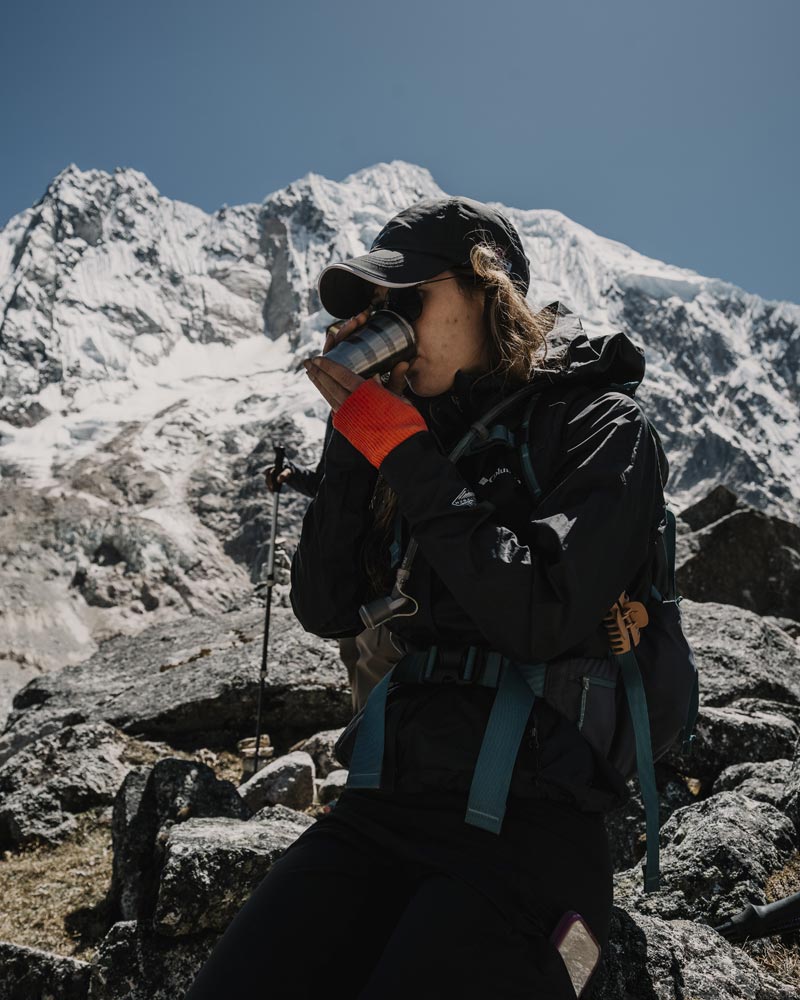
Being near Salkantay Mountain does not simply mean seeing a snow-capped peak from a distance. The experience around this summit combines glacial landscapes, lagoons, open valleys, and a very marked natural transition between the Andes and more humid areas near the edge of the jungle.
The most striking part is the contrast. In the same environment, you can move from cold, rocky landscapes dominated by snow to areas where the vegetation becomes denser and the air changes completely.
Landscapes Around the Snow-Capped Mountain
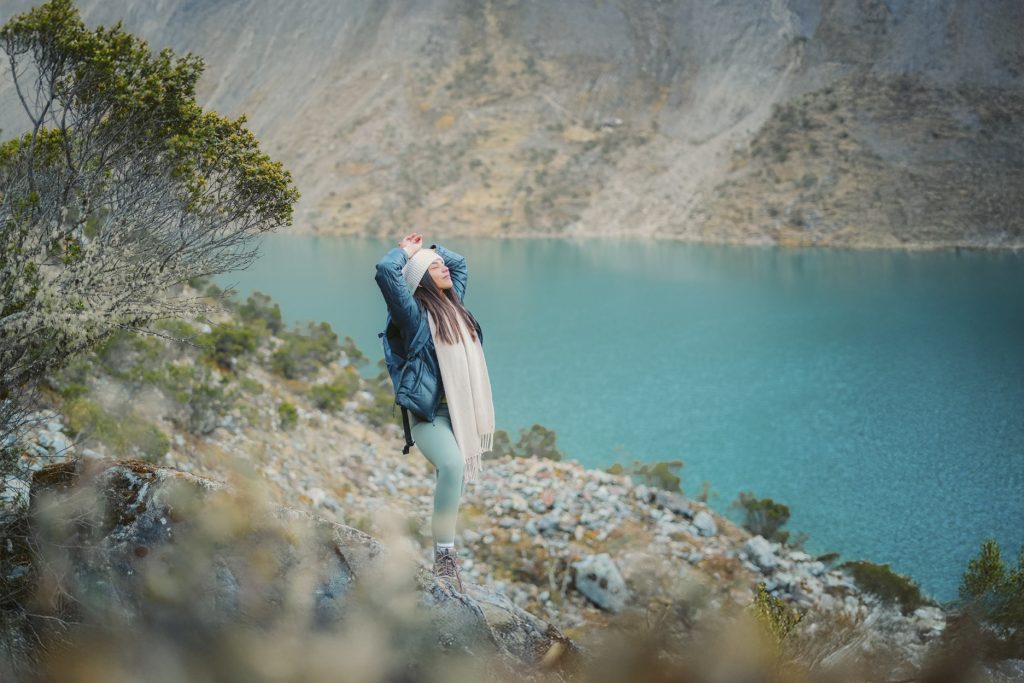
The landscapes around Salkantay are vast, intense, and highly photogenic. The area is marked by the presence of ice, deep ravines, high-Andean valleys, and mountains that change color depending on the light, cloud cover, and season.
Among the most representative landscapes in the area are:
- Snow-capped peaks that reinforce Salkantay’s imposing presence.
- Open, cold high-Andean valleys surrounded by mountains.
- Glacial lagoons, such as Humantay.
- Ravines and mountain passes where the scale of the landscape can be appreciated more clearly.
- Green transition zones toward more humid ecosystems.
This variety makes Salkantay a visually powerful destination. It is not just a mountain, but a natural setting where every change in altitude transforms the landscape.
Ecosystems: From the Andes to the Cloud Forest
One of the most special features of the area near Salkantay is the transition between ecosystems. The visual experience begins in a high-Andean environment, with cold, rock, ice, and sparse vegetation, and can continue toward more humid areas where cloud forests, greater biodiversity, and greener landscapes appear.
Visually, this means that near Salkantay, you do not only see snow-capped mountains. You also perceive how the landscape transforms: the air becomes more humid, vegetation increases, the valleys become narrower, and the colors of the surroundings shift from the gray and white tones of the highlands to more intense greens.
How to Discover Salkantay Mountain Up Close
The most complete way to experience Salkantay Mountain up close is to travel through its natural surroundings on a high-altitude route. This does not mean climbing the summit, since the technical ascent of the snow-capped mountain is reserved for expert mountaineers.
For most travelers, the real experience consists of getting close to its landscapes, observing its glaciers, walking through its valleys, and feeling the strength of Apu Salkantay from safe and accessible points.
Here, it is important to differentiate between two things: seeing the mountain and experiencing the landscape that surrounds it. You can see part of the surroundings from areas such as Soraypampa or Humantay, but to better understand its scale, climate, and natural diversity, the most representative experience is to take a guided route through the Salkantay corridor.
The Salkantay Trek: Brief Explanation
The Salkantay Trek to Machu Picchu is a hiking route that allows you to get close to the surroundings of Salkantay Mountain and then continue toward landscapes of valleys, cloud forests, and warmer areas before reaching the Machu Picchu area.
In this blog, it is not necessary to explain the itinerary day by day. What matters is understanding that the trek works as a way to experience the mountain up close, without attempting to climb it technically. It is an experience of landscape, altitude, culture, and natural connection.
Why It Is One of the Best Ways to See the Mountain
The Salkantay Trek is one of the best ways to see the mountain because it allows you to observe it within its own context: not only as a snow-capped summit, but as part of a natural system formed by ice, valleys, lagoons, high passes, and ecosystems that change with altitude.
Unlike a short visit, a hike through the area allows you to better perceive:
- The real scale of the snow-capped mountain.
- The change in climate between high-altitude areas and valleys.
- The transition from the Andes toward cloud forests.
- The spiritual relationship that many communities maintain with Apu Salkantay.
- The difference between looking at a mountain and walking within its landscape.
That is why, if after learning what Salkantay Mountain is you want to experience it more closely, the natural next step is to explore the complete guide to the Salkantay Trek to Machu Picchu.
Can You Climb Salkantay Mountain?
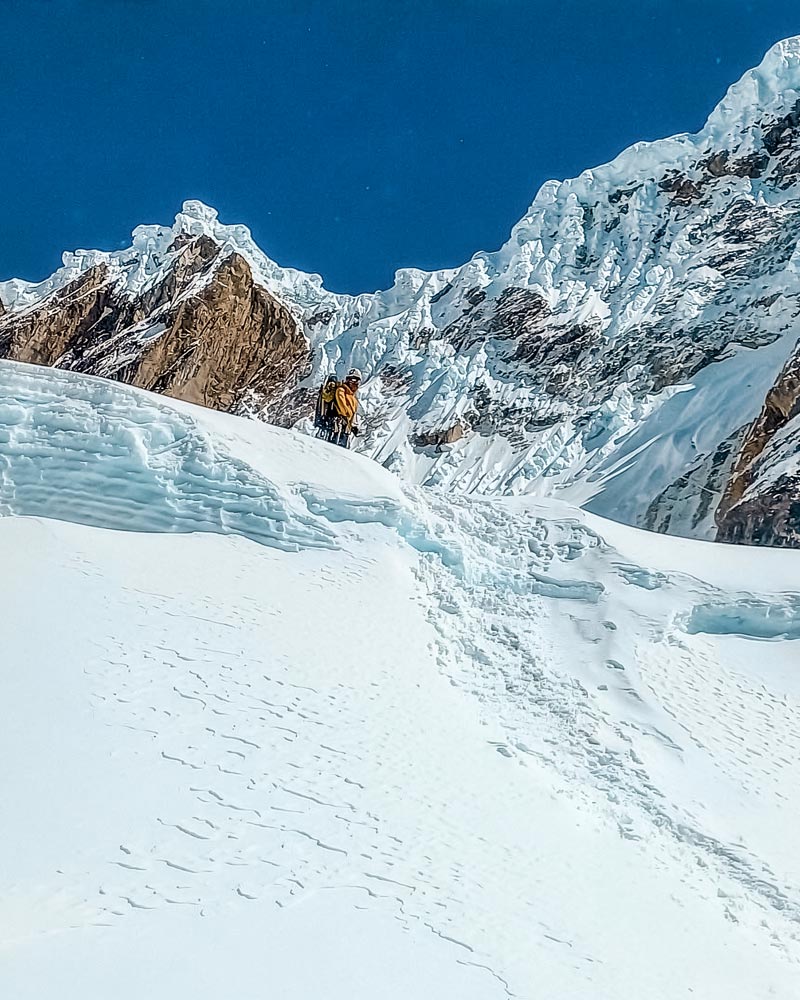
Yes, but climbing Salkantay Mountain is a technical mountaineering activity, not a tourist hike. Unlike nearby routes that allow you to observe the snow-capped mountain, reaching the summit requires glacier experience, rope management, advanced acclimatization, specialized equipment, and a high-mountain guide.
The first recorded ascent of Salkantay took place in 1952 by a French-American expedition. Since then, the mountain has been considered a technical and demanding summit reserved for mountaineers with experience in snow, ice, and glacial terrain.
For most travelers, the best way to get close to this mountain is not to climb it, but to observe its surroundings from safe routes and nearby natural viewpoints.
Technical Mountaineering, Not Conventional Hiking
Climbing Salkantay requires extreme physical preparation, high-mountain experience, and technical knowledge. It should not be confused with an excursion to Humantay Lake or with the Salkantay Trek.
In simple terms:
- Visiting the surroundings: possible for travelers with basic preparation and good acclimatization.
- Doing a nearby route: recommended with a guide and proper planning.
- Climbing the summit: only for experienced mountaineers.
If your goal is to see the snow-capped mountain, take photographs, understand its cultural importance, and experience its landscapes, you do not need to attempt to reach the summit. Getting close to its surroundings already allows you to appreciate the real strength of this mountain.
Is Salkantay Mountain Worth Visiting?
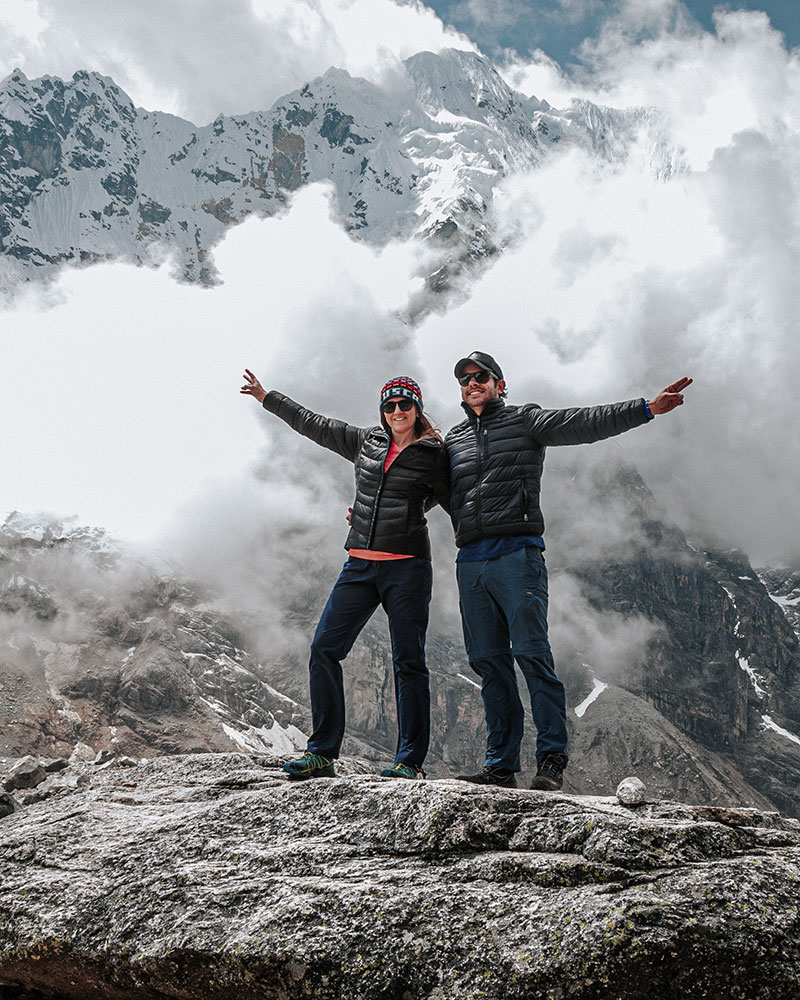
Yes, Salkantay Mountain is worth visiting, especially if you are looking for a natural experience that goes deeper than a simple mountain photo. Its value lies in the combination of altitude, glacial scenery, Andean culture, and a sense of vastness that few places in Cusco convey with such power.
However, it is worth understanding what kind of experience it offers. Salkantay is not an urban destination or an attraction with immediate access. It is a sacred high-altitude mountain, surrounded by valleys, lagoons, glaciers, and trails that require preparation for the weather, the altitude, and respect for the natural environment.
What Type of Traveler Should Visit It?
Salkantay is ideal for travelers who want to go beyond the classic circuits and better understand the sacred geography of the Andes. You do not need to be a mountaineer to appreciate its surroundings, but it is important to have an interest in nature, Andean culture, and high-altitude landscapes.
This destination can be a good choice for:
- Travelers interested in mountains, glaciers, and Andean landscapes.
- People who want to learn about the cultural meaning of the Apus.
- Lovers of nature photography and open landscapes.
- Visitors seeking a more authentic connection with the surroundings of Cusco.
- Travelers who want to better understand the natural context before doing a nearby route.
If your main interest is to learn what Salkantay represents for Andean Cusco, observe its surroundings, and understand its cultural importance, this article serves that purpose. If your goal is to plan a complete hike to Machu Picchu, the best next step is to continue toward our different Salkantay tour options.
What Makes It Unique
What makes Salkantay Mountain unique is its combination of natural strength and spiritual meaning. It is not just a high summit: it is a snow-capped mountain that dominates the landscape, feeds nearby ecosystems, and holds a special place within Andean cultural memory.
Its uniqueness can be summarized in four aspects:
- Altitude: it rises above 6,000 meters (19,685 feet) and forms part of Cusco’s high-altitude landscape.
- Geography: it brings together glaciers, ravines, lagoons, and transitional valleys.
- Culture: it is considered a sacred Apu within the Andean worldview.
- Visual experience: it allows you to see one of the most powerful contrasts between snow, rock, Andean sky, and greener ecosystems.
Visiting or getting close to Salkantay is not just about looking at a mountain: it is about coming into contact with one of the most important natural presences in southern Peru. For many travelers, that first encounter with Apu Salkantay becomes an invitation to explore, understand more, and experience the Andean landscape with new eyes.
Common Mistakes When Searching for Salkantay Mountain in Peru
Many people come to this topic with mixed questions, especially because the name Salkantay is used to refer both to the mountain and to the trekking route. To avoid confusion, keep these points in mind:
- Thinking that Salkantay is a directly accessible attraction.
- Confusing Salkantay Mountain with the Salkantay Trek.
- Believing you can reach the summit without technical experience.
- Underestimating the altitude of Soraypampa (3,900 m / 12,795 ft) and Humantay Lake (4,200 m / 13,780 ft).
- Not considering sudden weather changes.
- Searching for information about the snow-capped mountain when what you actually need is a trekking guide.
Frequently Asked Questions About Salkantay Mountain in Peru
Salkantay Mountain reaches approximately 6,271 meters / 20,574 feet above sea level. It is the highest summit in the Vilcabamba Mountain Range and one of the most iconic mountains in the Cusco region.
Yes, but climbing Salkantay is a technical high-mountain expedition, not a conventional hike. It requires mountaineering experience, glacier travel skills, specialized equipment, advanced acclimatization, and a professional guide.
Not exactly. Salkantay is a snow-capped mountain with glaciers on its slopes. Its glacial environment is part of what makes it visually impressive and environmentally important for the nearby valleys and ecosystems.
Salkantay Mountain is located in the Vilcabamba Mountain Range, in the Cusco region of southern Peru. It lies northwest of the city of Cusco, surrounded by glaciers, high-Andean valleys, and transitional landscapes.
For nearby areas such as viewpoints or short routes, a guide may not be mandatory, but it is recommended because of the altitude and weather. To climb the summit or take on demanding routes, a specialized guide is essential.
No. The highest mountain in Peru is Huascarán, at 6,768 meters (22,205 feet), located in the Áncash region. However, Salkantay is the highest summit in the Vilcabamba Mountain Range and one of the most representative mountains in Cusco.
The main difference is that Salkantay and Humantay are two different snow-capped mountains, although they are part of the same high-mountain landscape. Salkantay is a higher, more imposing summit and is associated with the famous trek to Machu Picchu. Humantay, on the other hand, is best known for the lake that forms at its base: Humantay Lake, located in the Soraypampa area. According to MINCETUR’s tourism inventory, the lake is located on the slopes of Humantay Mountain, while Apu Salkantay appears at the other end.
It is not common to see Salkantay Mountain from Cusco’s historic center because the distance, terrain, and nearby mountains block the direct view. To appreciate it better, it is best to get closer to areas such as Soraypampa, Humantay Lake, the Salkantay Pass, or certain points along the route to Machu Picchu. On clear days, it may be visible from some viewpoints or high areas outside the urban center, but it should not be presented as a usual view from the city.
Discover Salkantay Mountain and Explore the Route to Machu Picchu
Salkantay Mountain is more than a snow-capped peak in Peru. It is a sacred Apu, an imposing natural landmark, and one of the most impressive mountain landscapes in the Cusco region. Its elevation, glaciers, valleys, and cultural meaning make it a place that invites you to go beyond the typical postcard view and understand the Andes more deeply.
If this mountain has already caught your attention, the next step is to experience its landscape up close. The Salkantay Trek to Machu Picchu is one of the most memorable ways to walk near Apu Salkantay, cross high-altitude landscapes, and continue toward one of Peru’s most iconic destinations.