
Many travelers arrive in Cusco thinking that there is only one rainbow mountain, but the reality is quite different: in Cusco, you can visit several Rainbow Mountains in Peru, each offering a different experience. Vinicunca, Palcoyo, Pallay Punchu, and Wilcacunca are located above 4,700 meters (15,420 feet) and vary depending on the route, altitude, and type of hike. In this guide, we help you understand their differences so you can choose the best one for you.
- What are the Rainbow Mountains?
- Getting to know each mountain
- Vinicunca or Rainbow Mountain
- Palcoyo
- Pallay Punchu
- Which Rainbow Mountain to Choose?
- Are Rainbow Mountains Peru Worth Visiting?
- What should I bring to the mountains of colors?
- We are committed to sustainable tourism
- Plan your adventure! Discover all the tours to explore
- You may also be interested in:
What are the Rainbow Mountains?
The rainbow mountains in Peru are natural formations in the Andes mountain range that stand out for their red, yellow, and ochre stripes visible at high altitudes. They are located in the Cusco region, above 4,700 meters (15,420 feet), in areas where erosion has exposed ancient layers of the Earth.
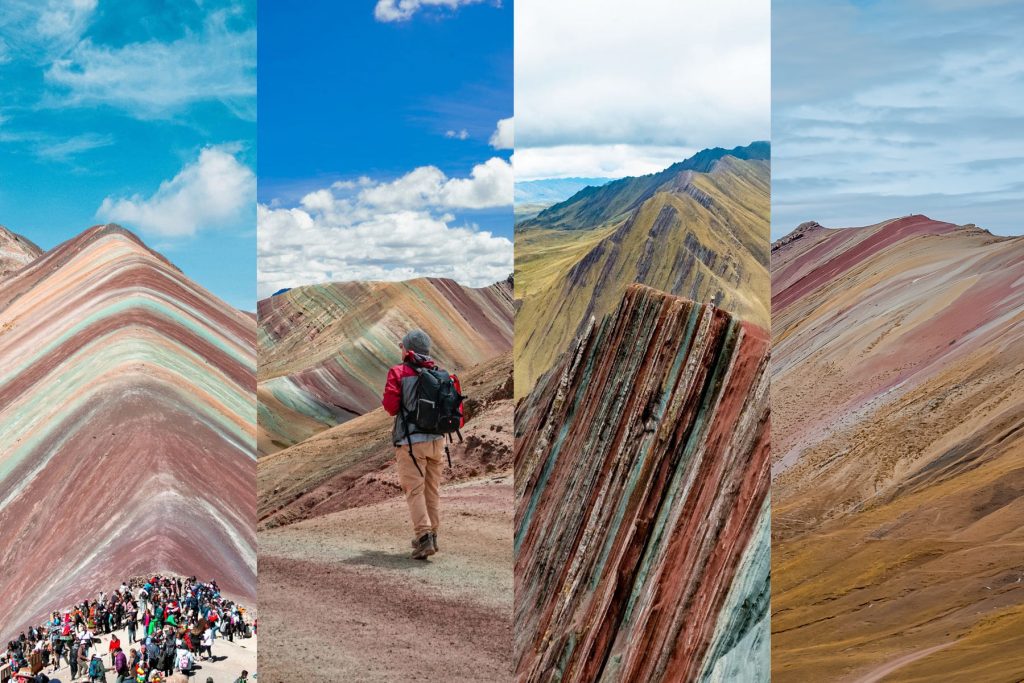
Although many travelers think there is only one, there are actually several colored mountains accessible from Cusco. Among the main ones are Vinicunca, Palcoyo, Pallay Punchu, and Wilcacunca, which are the ones that have become known so far.
Each offers a different experience in terms of landscape, hiking, and physical effort, so before choosing, it is important to understand where they are, how they were formed, and why they became so famous.
How were they formed?
These impressive natural landscapes full of colors are the result of a curious geological phenomenon that occurred millions of years ago. At that time, this area of the Andes was not a high mountain range, but a territory with seas, lagoons, and extensive plains where layers of sediment accumulated.
Over time, sand, clay, and different minerals were deposited on top of each other, forming layers with different compositions.
Later, the collision of tectonic plates raised these sediments during the formation of the Andes mountain range. As the land rose, each layer became tilted and compressed, but retained its original minerals.
The colors we see today come precisely from these minerals: iron produces reddish tones, sulfur produces yellows, and other compounds create greens and ochres.
For centuries, these layers remained covered by snow and ice. However, erosion, tectonic movements, and the retreat of glaciers exposed the colorful stripes that we can see today.
Therefore, these mountains are not painted, nor are they a visual effect. They are real geological layers, formed over millions of years.
Where are the colored mountains?
Peru’s four colored mountains are located in the Cusco region, within the Vilcanota mountain range, in the southern Cusco valley, at the opposite end of Machu Picchu. Several of them are located in areas near the Ausangate snow-capped mountain, one of the most important mountains in the Andes for local communities.
Although they belong to the same mountain range, they are not close to each other: each has its own access route and requires separate road trips and hikes. Some reach higher altitudes, such as Vinicunca, while others offer easier and more pleasant routes for tourists.
So, if you are looking for colorful Andean landscapes in Cusco, you have four different options to choose from. They all share the same geological origin, but the experience varies depending on the location, altitude, and how you get there.
Why are they so popular?
The popularity of the colored mountains is mainly due to their impressive visual impact. Unlike other Andean landscapes, here the colors do not appear only in small areas, but cover entire slopes visible from afar, creating striking contrasts with the sky and nearby snow-capped mountains.
In addition, the journey to reach them allows visitors to enjoy expansive high mountain landscapes such as Ausangate and the Red Valley. From different points along the way, visitors can observe constant changes in the environment, which makes the hike as important as the final view.Thanks to this combination of high altitude, open landscapes, and well-defined natural colors, these mountains are considered one of the most striking settings in the Cusco region.
Getting to know each mountain
Not all seven-colored mountains are experienced in the same way. Although they may seem similar at first glance, each one offers a different experience marked by the route, altitude, and type of hike. Some are more physically challenging, while others allow you to enjoy the landscape at a more leisurely pace, but all connect you with the immensity of the Andes.
Knowing their differences is the first step in choosing the mountain that best aligns with your pace, your experience, and the way you want to experience this encounter with nature.
Let the adventure begin!
Vinicunca or Rainbow Mountain
Rainbow Mountain, known locally as Vinicunca, is the starting point for the world-famous colored mountains in Cusco. For years it remained almost unknown, until in 2016 it began to appear in international magazines and media, quickly positioning itself as one of the best tourist destinations in Peru.
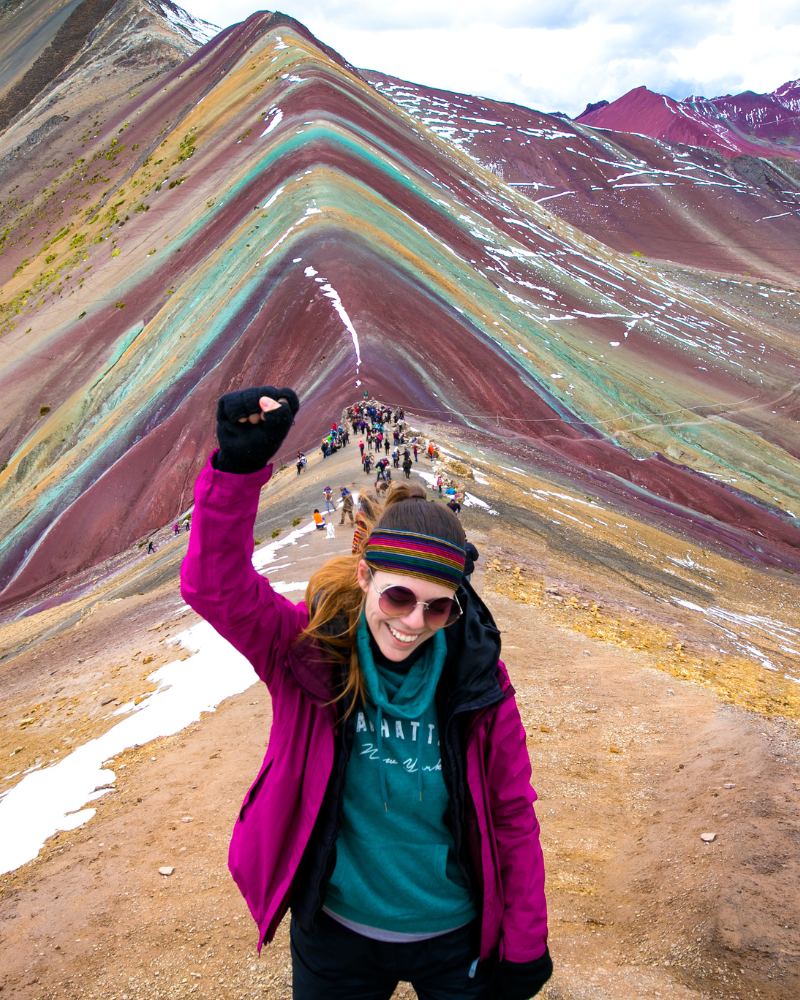
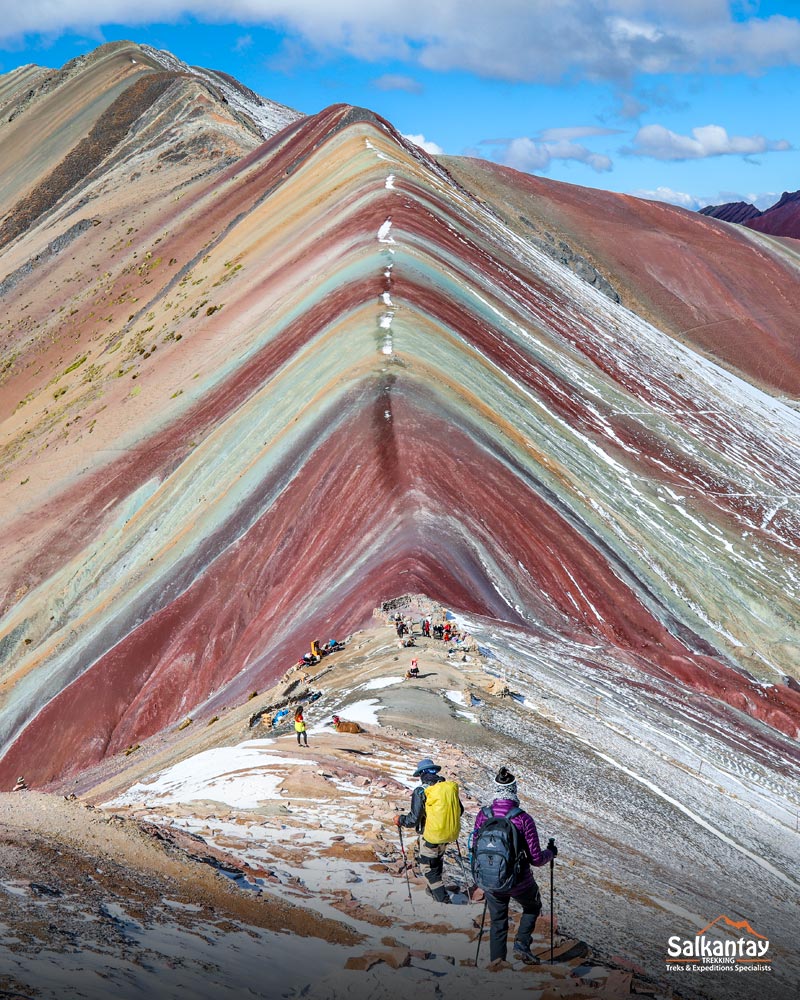
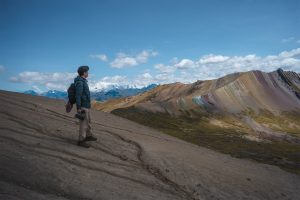
Its recognition is no accident: its slopes clearly display the seven colors that characterize it, predominantly red, pink, yellow, green, brown, white, and turquoise, a natural result of the mineral concentration present in the mountain.
To reach it, the landscape transforms step by step. You cross extensive high Andean pampas where llamas, alpacas, and vicuñas graze freely, while the imposing snow-capped Ausangate mountain dominates the horizon. The combination of snow, open sky, and mineral veins creates a unique contrast that accompanies the entire hike.
What makes Vinicunca special is not only its appearance, but also the feeling of walking through a living environment, where the mountain maintains a deep connection with the local communities and their way of understanding nature. Each section of the trail allows you to appreciate this simple and authentic relationship.
With an altitude reaching 5,100 meters above sea level / 16,732 feet, this is also the most challenging mountain of colors. The altitude makes the climb challenging, but the reward is absolute. Upon reaching the summit, the multicolored panorama opens up completely, enveloping you in a setting that is not only observed but experienced with all the senses.
Important Information
| Name | Vinicunca |
| Location | Pitumarca (4 hours from Cusco) |
| Maximum altitude | 5,100 meters above sea level / 16,732 feet |
| Hiking time (round trip) | 3 to 4 hours |
| Hiking distance | 7 km / 4.35 miles |
| Activity level | Challenging |
| Entrance fee | 15 soles (5 USD) for Peruvians and 25 soles (8 USD) for foreigners. |
| Best time of year to visit | May, August, and September |
How to Get There
There are two main ways to get to Vinicunca Rainbow Mountain: on your own or with an organized tour. Below, we explain each option.
On your own:
If you decide to travel without a tour, you should know that there are two main routes, both with a similar walking time.
Cusipata Route
For this route, you must take a taxi or vehicle to Huayropata Avenue, where the bus terminal with departures to Sicuani is located. From there, there are several transportation options, although the ideal is to find a bus going directly to Cusipata.
If there is no availability, you can also take a bus to Sicuani, making sure to tell both the ticket seller and the driver that you will be getting off at Cusipata. The usual cost of this trip is 10 soles (approx. $2.98), while direct buses usually cost around 14 soles ($4.18).
Upon arrival in Cusipata, there are shared buses and taxis that continue on to Phulawasipata, the starting point of the hike. This leg costs 25 to 30 soles (USD 8 to 9) and takes between one and one and a half hours, depending on the transportation chosen.
From Phulawasipata, the hike to the Mountain of Colors begins, a round trip of approximately 7 kilometers (4.35 miles), with an estimated duration of 2 to 3 hours and a well-marked trail to Vinicunca. If you get tired, it is possible to rent a horse for some sections of the trail.
Checacupe Route
This is a lesser-known alternative with fewer visitors. Like the Cusipata route, the journey begins on Huayropata Avenue, where you must take a bus bound for Checacupe. If there is no direct bus, you can take a bus to Sicuani, indicating in advance that you will get off at the Checacupe stop.
Once in Checacupe, continue by bus or taxi to Pitumarca, at an approximate cost of 30 soles (USD 9). Upon arrival, you will need to arrange a private taxi to Kayrawiri, as there is no direct public transportation for this section. For this reason, it is recommended to join other travelers and share expenses. The cost of the transfer usually varies between 15 and 25 soles (USD 4 to 7) each way.
Kayrawiri marks the start of the hike. From this point, it is approximately 7 kilometers (4.35 miles) round trip to the Mountain of Colors, on a well-marked trail that takes about two and a half hours. One of the main advantages of this route is that there are fewer tourists. In addition, for those who wish, there is the option of renting motorcycles or ATVs for some sections of the trail.
Tip: It is important to bring cash, preferably in soles and in small bills, as local transportation only accepts the national currency.
With an Organized Tour:
This is the most comfortable and easiest way to visit Vinicunca. Operators specializing in high mountain trekking, such as Salkantay Trekking, take care of all the logistics: transportation, guide, entrance fees, and meals, including a buffet lunch. Although it may seem like an expensive option, there are different alternatives that allow you to tailor the experience to different budgets.
In addition to convenience, an organized tour offers safety and constant accompaniment, which is essential considering the altitude of the mountain. In case of altitude sickness, the team has oxygen tanks and trained personnel to assist and support you during the tour.
You can explore more about this mountain on our blog: Mountain of 7 Colors: Vinicunca, Everything You Need to Know.


Palcoyo
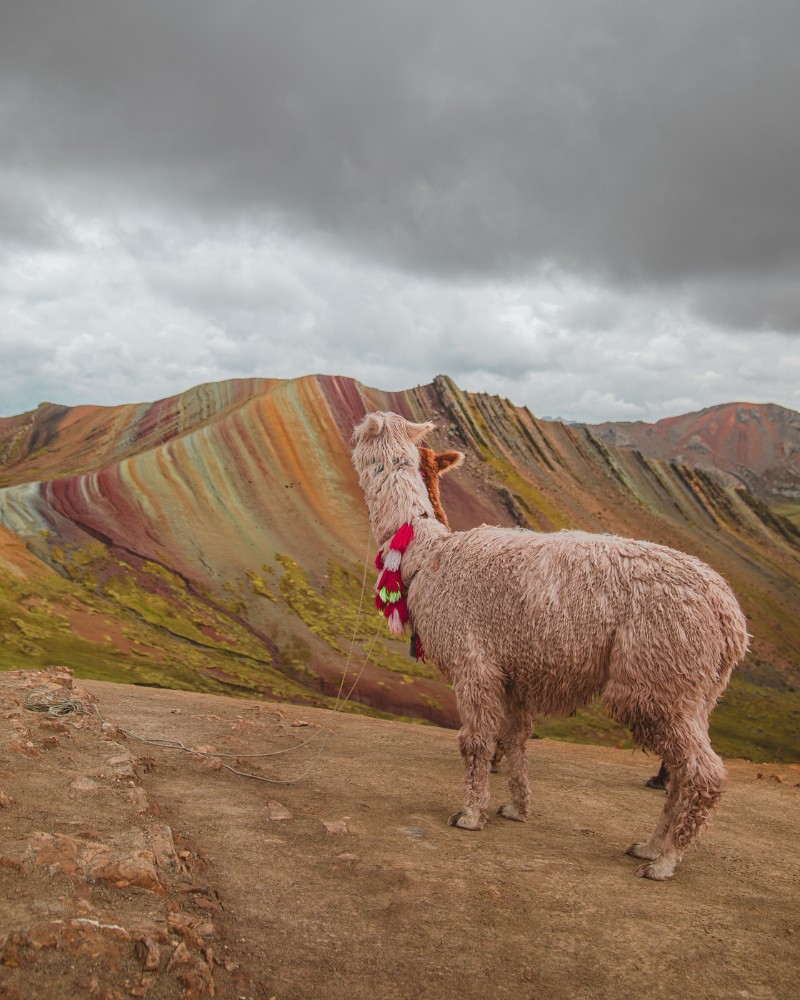
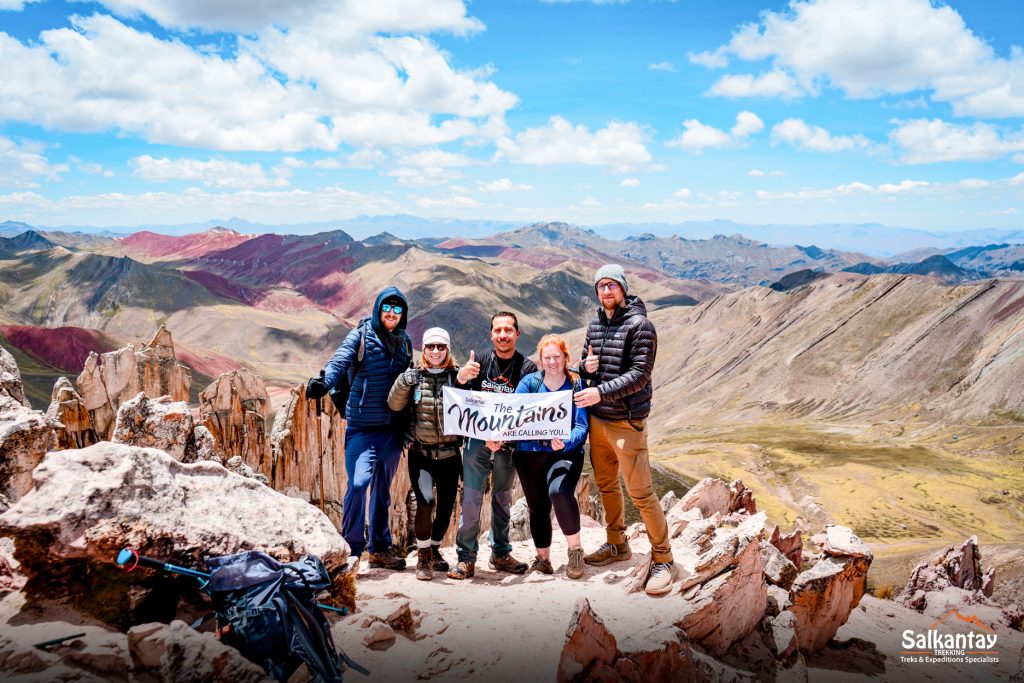
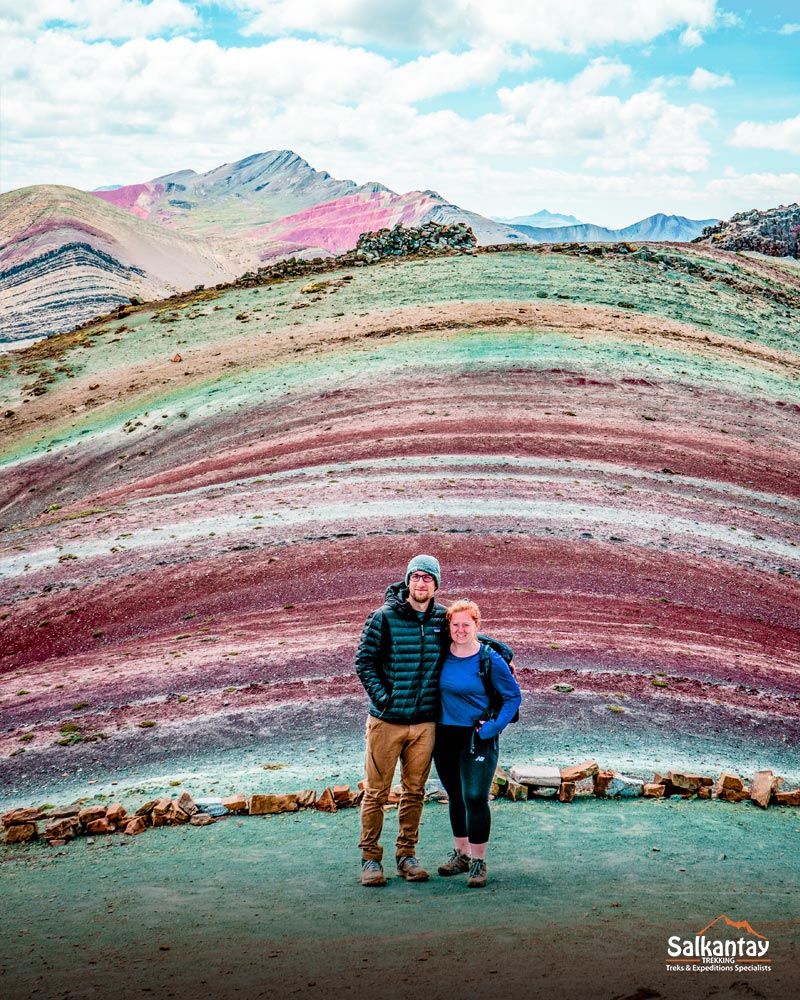
It is often referred to as the second best-known rainbow mountain, but that definition is not entirely accurate. Palcoyo is not a single mountain, but a mountain range formed by three rainbow mountains that extend together. Like Vinicunca, it has a magnificent range of colors, which has made it a highly valued alternative route for travelers. The big difference is the lower altitude and a much easier hike.
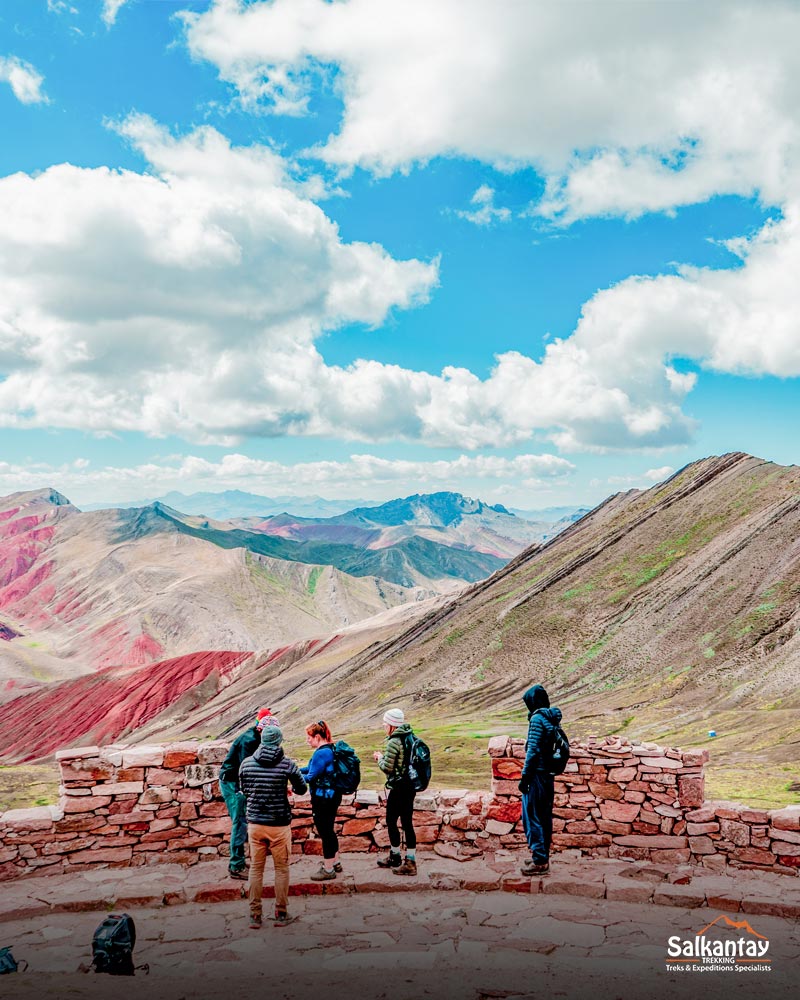
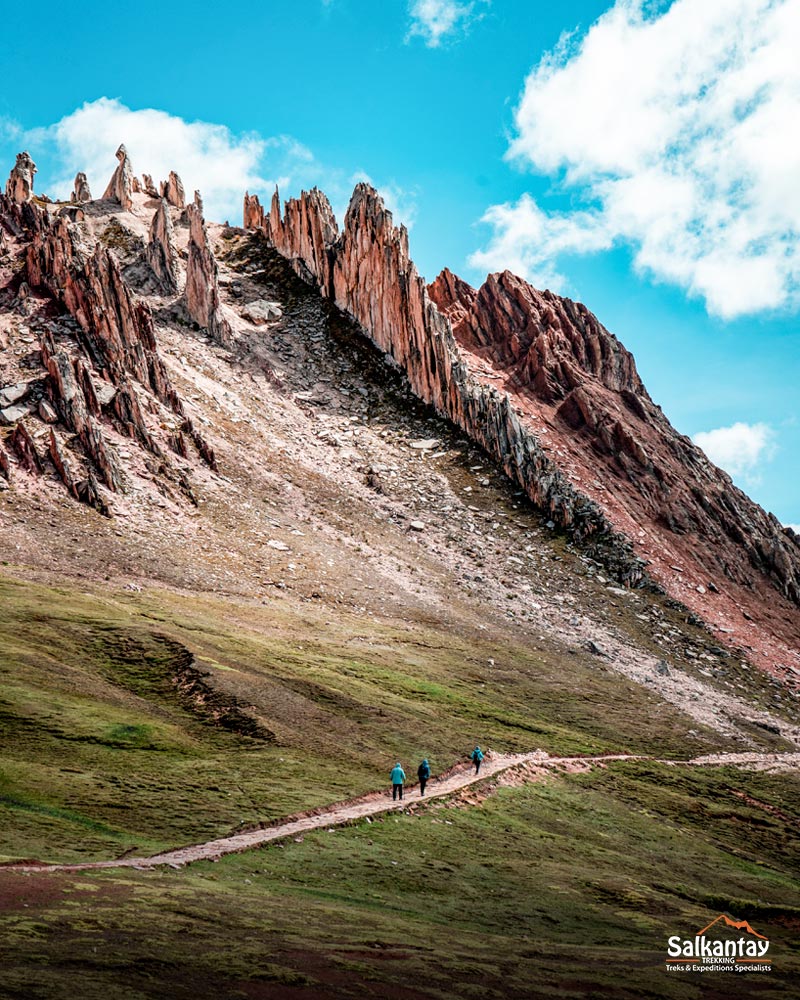
Thanks to these characteristics, Palcoyo is ideal for those who want to enjoy spectacular landscapes without crowds and at a more leisurely pace. Here, the trail can be enjoyed calmly, allowing you to stop as many times as necessary to observe the surroundings and take pictures. The access is already part of the experience: during the tour, you will cross the Red Valley and an impressive stone forest, where sharp-pointed rock formations rise toward the sky, creating a surprising setting that conveys a feeling of smallness in the face of the immensity of the landscape.
At your own pace, you can climb up to 4,900 meters above sea level (16,076 feet), where you will enjoy a privileged view of Ausangate Snow-capped Mountain, the highest mountain in Cusco, at 6,372 meters above sea level (20,905 feet). At this point, the silence of the Vilcanota Mountain Range envelops the entire route, reinforcing the feeling of being in a pure and unspoiled environment.
The experience is completed with a visit to Checacupe, a town near Palcoyo. This small town is notable for its three historic bridges, belonging to the Inca, colonial, and republican eras, which reflect different stages of Andean history.
Overall, Palcoyo offers a different alternative to the classic Mountain of Colors: a more accessible route, varied landscapes, and a peaceful atmosphere that make this hike a unique experience in the Cusco Andes.
Important Information
| Name | Palcoyo |
| Location | Checacupe (4 hours from Cusco) |
| Maximum altitude | 4,900 meters above sea level / 16,076 feet |
| Hiking time (round trip) | 2 to 3 hours |
| Hiking distance | 3 km / 1.86 miles |
| Activity level | Moderate |
| Entrance fee | 10 soles (3 USD) for Peruvians and 20 soles (6 USD) for foreigners. |
| Best time of year to visit | April, May, and September |
How to Get There
There are two ways to visit Palcoyo: on your own or through an organized tour. Each option offers a different experience depending on the level of comfort you are looking for.
On Your Own:
First, you must go to Avenida Huayropata No. 1703, near the Inca Garcilaso de la Vega stadium, where you will find the bus terminal for Sicuani. Several companies operate there; ask the ticket seller if the bus stops in Checacupe. If the answer is yes, you can buy your ticket. The ticket costs an average of 12 soles (USD 4) and the journey takes approximately two and a half hours.
When you arrive in Checacupe, you can walk about 10 minutes to the main square or take a taxi for around 4 soles (USD 1.19). Very close to the square, you will find the famous three historic bridges (Inca, colonial, and republican), an additional attraction of the place.
From the plaza, you can take a bus or arrange a private taxi to the community of Palcoyo. The trip takes approximately 1 hour and 20 minutes. A private vehicle usually costs around 100 soles (USD 30) round trip. Once you have paid the entrance fee, a short 45-minute walk to the rainbow mountains awaits you. During the walk, you will pass through the impressive stone forest, one of the most striking formations in the area.
Key fact: Palcoyo is a less frequented destination, so transportation to the mountain can be limited. The best option is to organize with other travelers and share a vehicle to facilitate access.
With an organized tour:
If you prefer to avoid complications, we offer tours to Palcoyo that allow you to focus solely on enjoying the experience. Specialized operators such as Salkantay Trekking take care of all the logistics: transportation, guide, entrance fees, and meals.
The route follows the same general path, but with the advantage of traveling safely and in an organized manner. In addition, a buffet breakfast is included before starting the hike. If you are still in the process of acclimatization, it is recommended to opt for light foods.You will be accompanied at all times during the hike. Although the route is short, the altitude can be challenging. For this reason, the team is trained in first aid and carries oxygen tanks as a preventive measure. These cases are rare, but being prepared ensures greater peace of mind.
If you would like to learn more about this mountain, you can explore our blog: Rainbow Mountain: Palcoyo, everything you need to know.
Pallay Punchu
Pallay Punchu did not emerge as a planned tourist destination. It became known during the COVID-19 quarantine, when Tony Ccalta, a local resident, went out in search of medicinal plants for his parents near Laguna Langui. On that trip, he spotted a mountain with sharp edges and intense colors. He decided to climb it, was amazed by the landscape, and shared photos and videos on his social media accounts. Virality did the rest. In a short time, travelers and digital communities began to take an interest in the place, which today ranks as the third most visited rainbow mountain in Cusco.
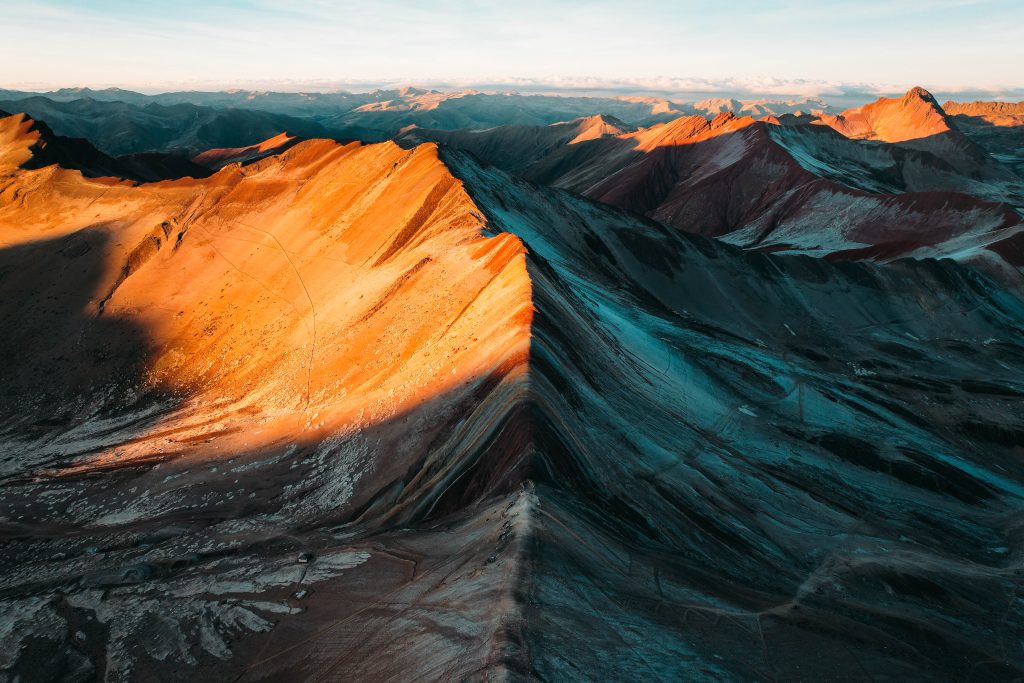
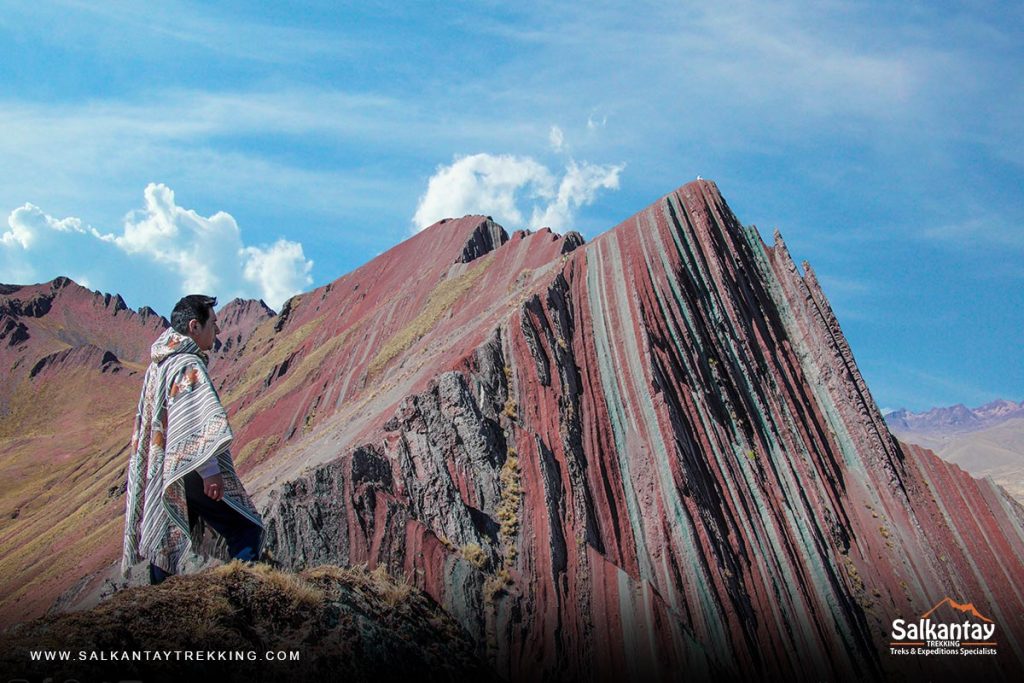
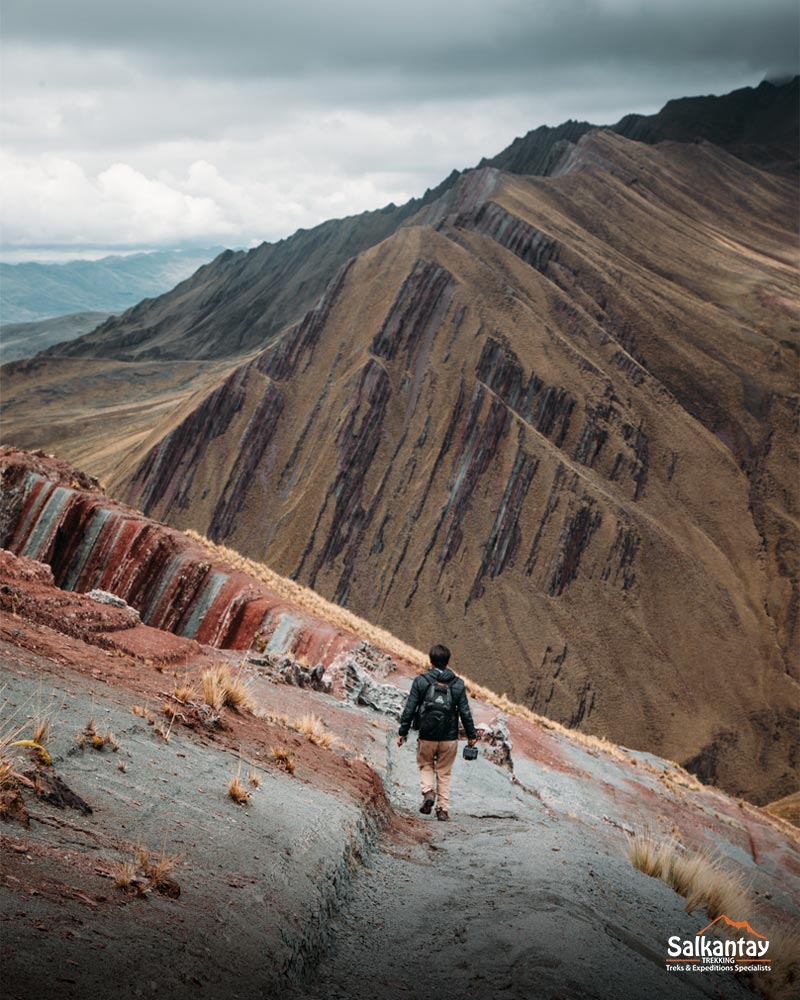
The name also has a special history. This geological formation has pointed ridges and colorful stripes that combine in a very unique way. The arrangement of its hues is reminiscent of the designs of a woven Andean poncho. For this reason, the locals named it Pallay Punchu, a Quechua expression that means “decorated poncho.”
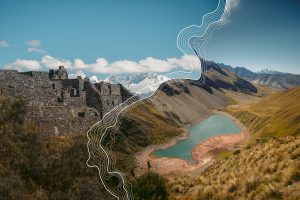
To reach this extraordinary destination, you first pass by the impressive blue lagoon of Langui, which offers a landscape worth contemplating at leisure. From there, a hike of approximately two hours begins until you reach the summit. During the ascent, the surroundings open up into wide panoramic views, allowing you to clearly appreciate the perfectly marked lines of the mountain, where shades of cyan, brown, and magenta stand out in contrast to the Andean sky.
Important Information
| Name | Pallay Punchu |
| Location | Layo (4 hours and 15 minutes from Cusco) |
| Maximum altitude | 4,700 meters above sea level/15,419 feet |
| Hiking time (round trip) | 1 to 2 hours |
| Hiking distance | 3 km / 1.86 miles |
| Activity level | Moderate |
| Entrance fee | 10 soles (3 USD) for Peruvians and foreigners. |
| Best time of year to visit | June, July, and August. |
How to Get to Pallay Punchu
There are two options for visiting Pallay Punchu: do it on your own or choose an organized tour. Below, I will explain each alternative clearly.
On Your Own:
Layo Route:
First, you must go to Huayropata Avenue, where you will find the bus terminal for Sicuani. There you can buy the ticket you prefer; some buses make more stops and others are more direct, so travel time may vary. The journey takes approximately 3 hours and the ticket costs an average of 12 soles (USD 3.58).
Once in Sicuani, you must take a bus to the district of Layo, located approximately 1 hour away. The cost is around 5 soles (USD 1.49). Generally, the bus will drop you off near the starting point of the hike to Pallay Punchu. From there, the ascent takes about 2 hours, and the return trip takes a similar amount of time.
Occobamba Route:
This route follows the same path to Sicuani. The difference is that from there you must take a taxi to the town of Occobamba, at an approximate cost of 4 soles (USD 1.19). The hike begins from this point.
This alternative is a little more demanding, so it is recommended that you be in good physical condition and well acclimatized. The ascent takes approximately 2.5 hours, so the entire route (round trip) can take about 5 hours.
Organized tour:
If you prefer to avoid logistical complications, you can opt for the one-day tour to Pallay Punchu offered by Salkantay Trekking. In this option, transportation is provided directly from your hotel. During the trip, there is a stop in Cusipata to enjoy an energizing breakfast before continuing on to Marangani, near Occobamba.
From this point, the hike begins, which can take between 1 and 2 hours, depending on your pace and physical condition. The service includes transportation, logistics, meals, and a professional guide. In addition, the team provides constant support during the hike and carries oxygen tanks as a preventive measure. Due to the high altitude, some people may experience mild discomfort typical of this environment.
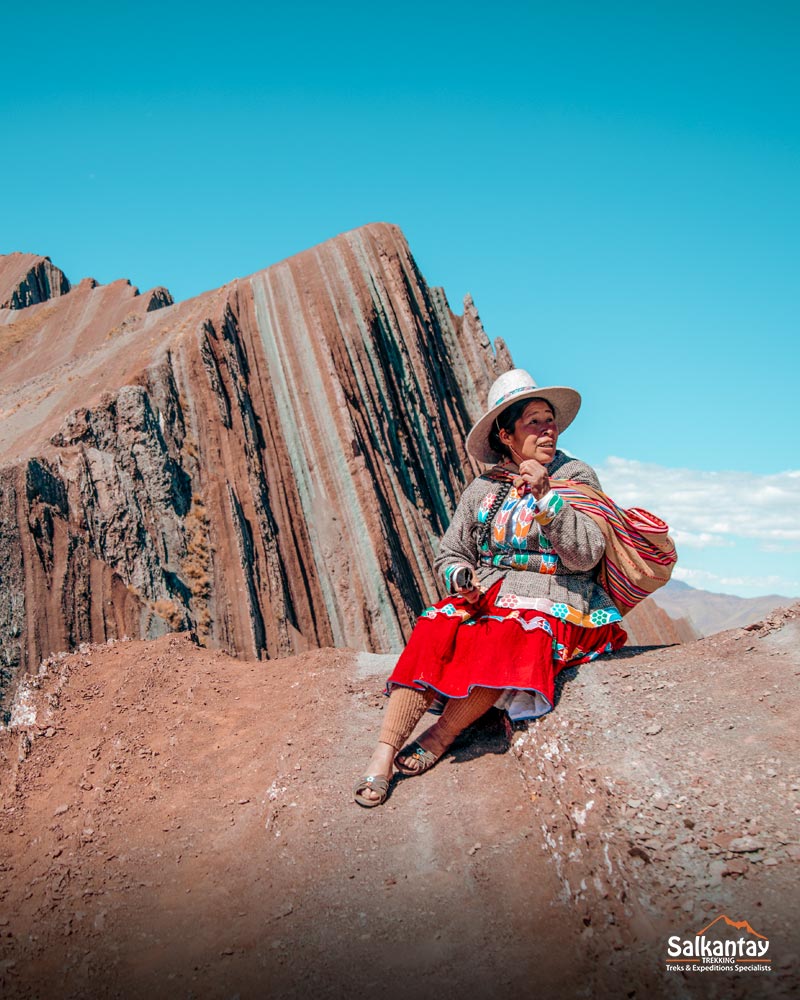
Exploring Pallay Punchu is a unique experience in the rainbow mountains. We recommend bringing your Andean poncho to capture memorable photographs and enjoy not only the landscape, but also the cultural and geological richness that characterizes the Peruvian Andes.
You can explore more about this mountain in our blog: Rainbow Mountain: Pallay Punchu, Everything You Need to Know.


Wilcacunca
Wilcacunca is, to date, one of the most recently publicized colored mountains in the Cusco region. It is also known as the mountain of love, a name that comes from local stories that say that, in the past, this place was the scene of symbolic ceremonies where couples swore their love before the Apus to receive their blessing. Although this practice is no longer carried out today, the tradition remains in the memory of the area.
It is located near Vinicunca, the best-known rainbow mountain. Due to their proximity and the fact that both have similar mineral veins, there was confusion among the locals for a time, who referred to both as Vinicunca. However, with the passage of time and better identification of the territory, it was recognized that they were different formations and the name Wilcacunca began to be used to differentiate them.
In terms of appearance, Wilcacunca displays shades of red, yellow, orange, turquoise, and dark tones, which are the result of the mineral composition of the soil. Unlike Palcoyo, which is part of a mountain range with several colorful mountains, Wilcacunca, like Vinicunca, stands out mainly for a single mountain with well-defined veins.
From its summit, you can enjoy a privileged view of Ausangate Snow-capped Mountain, considered one of the most important Apus in the southern Andes. In addition, there are little-known archaeological remains in the surrounding area, such as Machupitumarca and Inca Cancha, which add additional historical value to the tour.
Wilcacunca thus offers a less crowded experience that is still in the process of becoming established as a tourist destination, ideal for those seeking to explore a different alternative within the colorful mountains of Cusco.
Important information
| Name | Wilcacunca |
| Location | Between the communities of Uchullucllu and Qallanqa (3 hours and 20 minutes from Cusco) |
| Maximum altitude | 4,950 meters above sea level / 16,240 feet |
| Hiking time (round trip) | 3 to 4 hours |
| Hiking distance | 4 km / 2.49 miles |
| Activity level | Moderate |
| Entrance fee | 10 soles (3 USD) for Peruvians and 30 soles (9 USD) for foreigners. |
| Best time of year to visit | June to September. |
How to get there
On your own
To get to Wilcacunca on your own, you must first go to Huayropata Avenue, where you will find the bus terminal for Sicuani. There you can take a bus and indicate that you want to get off at Checacupe. The fare to this area is approximately 12 soles (USD 3.58).
Once in Checacupe, you can walk to the main square, very close to the famous three historic bridges, and from there hire a private taxi. As a reference, you should indicate that you are going to Uchullujllo, passing through Pitumarca, and ask to be dropped off at the starting point of the hike to Wilcacunca. The cost of the private taxi may vary depending on negotiation and season.
From the start of the trail, the hike takes approximately 2 hours to ascend and another 2 hours to return. Upon arrival, you will need to pay the corresponding entrance fee, administered by the local community.
Important recommendation: Wilcacunca is a relatively new destination and the trail is not always clearly marked. Therefore, it is advisable to opt for a private tour or to be accompanied by someone who knows the way to avoid getting lost during the hike.
With an organized tour
Currently, some tour operators already offer private and group tours to Wilcacunca. Prices vary depending on the number of people and the type of service. For example, in a group of four people, the cost can be around USD 120 per person, although this rate may change depending on the season and the services included.
Which Rainbow Mountain to Choose?
It’s normal to feel a little indecisive with so many attractive options. To help you choose between the most famous colored mountains in Cusco, we present a clear and straightforward comparison. This will allow you to quickly evaluate aspects such as altitude, difficulty, type of landscape, and level of traffic, and decide which one best suits your pace and expectations.
| Feature | Vinicunca | Palcoyo | Pallay Punchu | Wilcacunca |
| Maximum altitude | 5,100 m/16,732 ft | 4,900 m/16,076 ft | 4,700 m/15,419 ft | 4,950 m/16,240 ft |
| Hike duration (round trip) | 3 to 4 hours | 2 to 3 hours | 1 to 2 hours | 3 to 4 hours |
| Difficulty | High | Low–Moderate | Low | Low |
| Travel time (by car) | 8 hours | 7 hours and 20 min | 8 hours and 40 min | 6 hours and 30 min |
| Hiking assistance options | ATVs and horses | ATVs and horses | Not necessary | Horses |
| Visible colors | Reds, greens, yellows, whites, turquoises, browns, and pinks | Reds, ochres, yellows, greens, browns, whites | Reds, browns, magentas, grays, cyans | Reds, yellows, oranges, turquoises, browns, dark colors |
| Type of landscape | Main mountain | Three-mountain range | Sharp, poncho-like ridges | Main mountain |
| Visitor numbers | High (≈800-2,000 per day in high season) | Medium-Low (≈150-600 per day in high season) | Low (≈80-300 per day in high season) | Low (≈40-200 per day in high season) |
| Entrance fee | 15 soles (5 USD) for Peruvians and 25 soles (8 USD) for foreigners. | 10 soles (3 USD) for Peruvians and 20 soles (6 USD) for foreigners. | 10 soles (3 USD) for Peruvians and foreigners. | 10 soles (3 USD) for Peruvians and 30 soles (9 USD) for foreigners. |
| Nearby attractions | View of Ausangate Snow-capped Mountain, Corazón Lagoon, and viewpoints | Stone Forest and Red Valley | Langui Lagoon and the ruins of Quishuar Cancha | View of Ausangate, Machupitumarca, and Inca Cancha |
The three rainbow mountains offer vibrant landscapes and unique experiences that will remain in your memory. Each one has its own charm and distinctive characteristics, so the choice between them depends on your personal preferences and fitness level.
Are Rainbow Mountains Peru Worth Visiting?
Yes, definitely worth it. But not just for the iconic photograph that everyone wants to replicate, but for what it means to be up there.
The rainbow mountains of Cusco are not just a viewpoint; they are natural settings that combine geological history, Andean culture, and landscapes that seem unreal. Each one offers a different experience: the visual intensity of Vinicunca, the panoramic expanse of Palcoyo, the uniqueness of Pallay Punchu, or the tranquility of Wilcacunca. No matter which one you choose, the visual impact is immediate and difficult to forget.
Of course, visiting these mountains means leaving your comfort zone and venturing into a high mountain environment. The experience can feel different depending on the day, the weather, and how your body responds. And that’s part of its authenticity: it’s not a static landscape, it’s a living environment.
Prepare for altitude sickness
One of the most common mistakes when visiting Cusco is underestimating the altitude. Although many people believe that adapting is easy, the body needs time to adjust.
The city of Cusco is located at 3,400 meters above sea level (11,155 feet), and most excursions to the rainbow mountains exceed 4,600 meters (15,092 feet), reaching in some cases up to 5,100 meters (16,732 feet).
Therefore, acclimatization is not a minor detail, but a fundamental part of your experience. Arriving at least two days before any hike will help your body adapt gradually so you can enjoy the tour with greater safety and energy.
If you want to learn more about this topic, we recommend reading our full blog: How to Acclimate in Cusco: Everything You Need to Know.
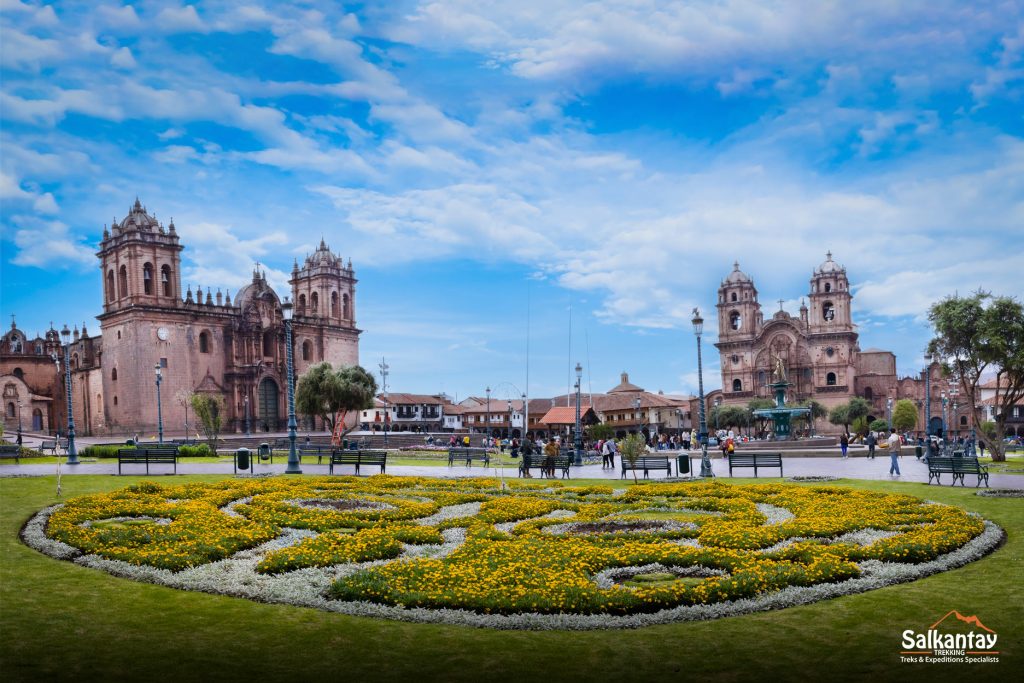
How to Prevent Altitude Sickness
If your body is not used to the decrease in oxygen at high altitudes, you may experience symptoms such as headache, fatigue, nausea, or difficulty breathing. These recommendations may help:
- Stay hydrated: Altitude can cause rapid dehydration, so it is important to drink water constantly.
- Don’t push yourself: Once in Cusco, it’s good to explore and walk around the streets to get used to the altitude, but do so calmly and at your own pace.
- Get plenty of rest: Your body is working hard to adapt to the altitude, so it’s essential that you get plenty of rest.
- Eat properly: Avoid heavy foods that can cause slow digestion and stomach pain.
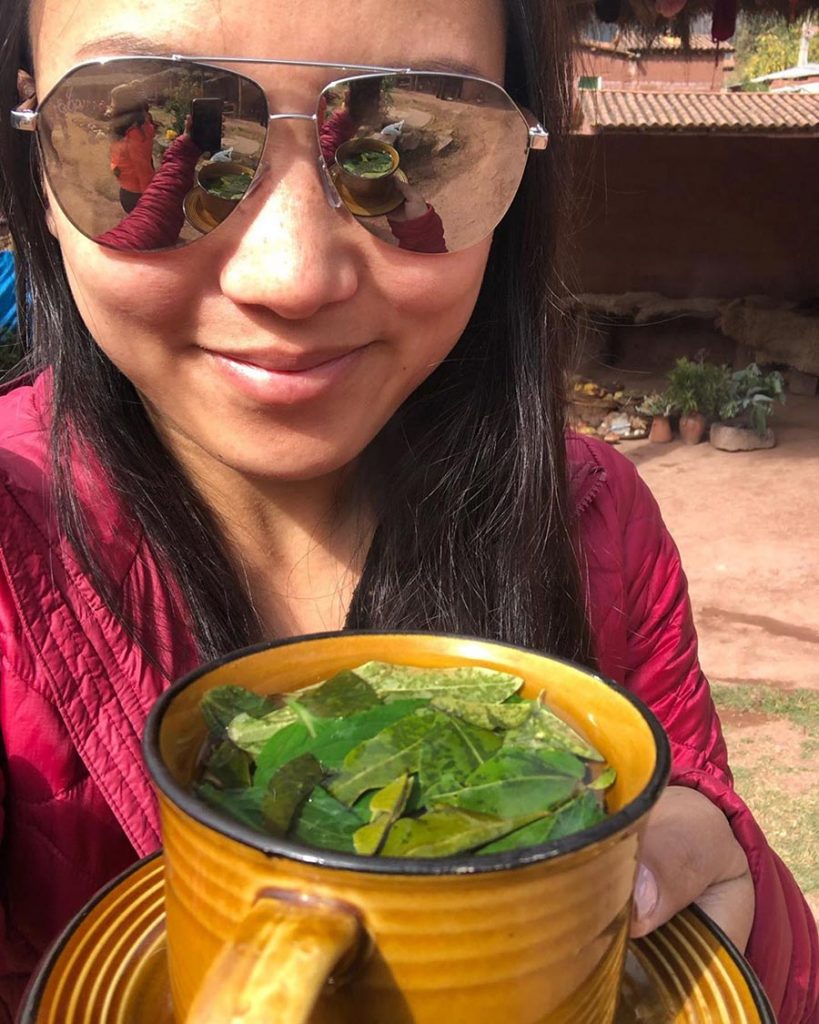
- Drink coca tea: In the Andes, coca leaves are a traditional and natural remedy that helps relieve the symptoms of altitude sickness. It can also be combined with other native plants, such as muña.
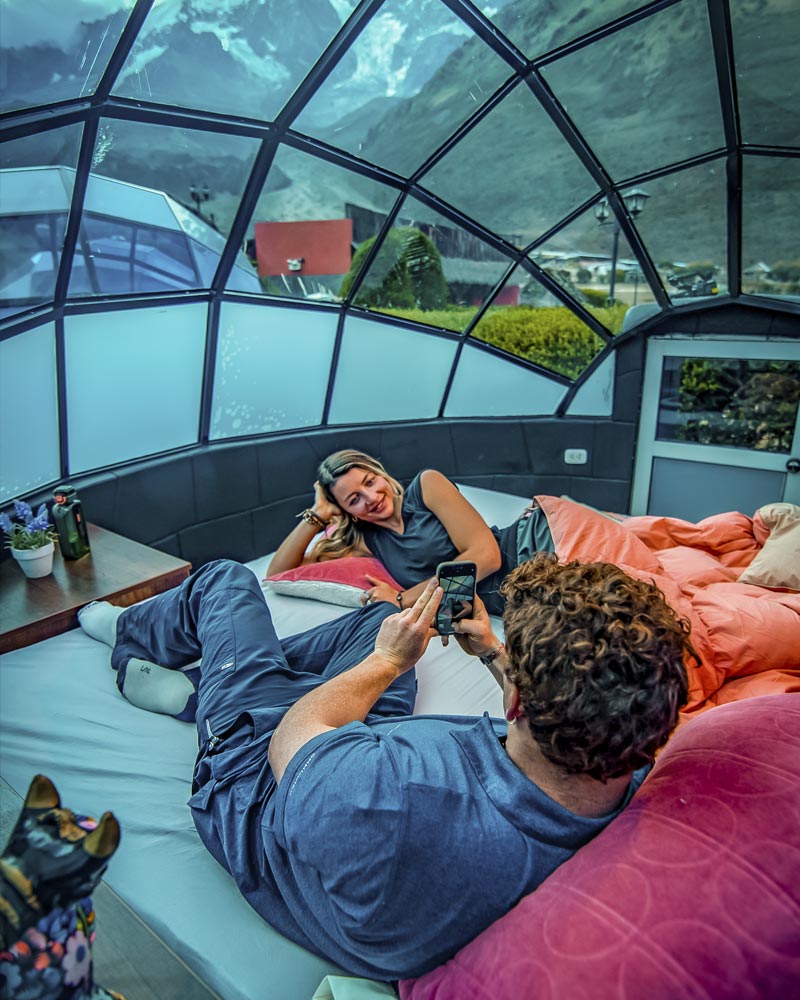
Weather can influence your trip
Visiting the rainbow mountains depends not only on choosing the destination or hike, but also on understanding how the average weather can influence your experience. These routes are located in high-altitude areas, where weather conditions are very different from those in the city or the Sacred Valley, and vary both by season and by the Andean geography itself.
The climate is typically Andean: cold, dry, and windy. The average daytime temperature usually ranges between7°C and 15°C (45°F and 59°F), even in the dry season, and can drop significantly at night or at the summit. Strong winds are common, especially in cold months such as June and July, and can intensify the feeling of cold.
For many, the unpredictable weather, cold wind, possibility of snow, or clouds over the mountains enrich the adventure and give character to the landscape. For others, it can be an additional challenge if they are not prepared. In the next section, we explain how to get everything ready to enjoy this experience safely and comfortably.
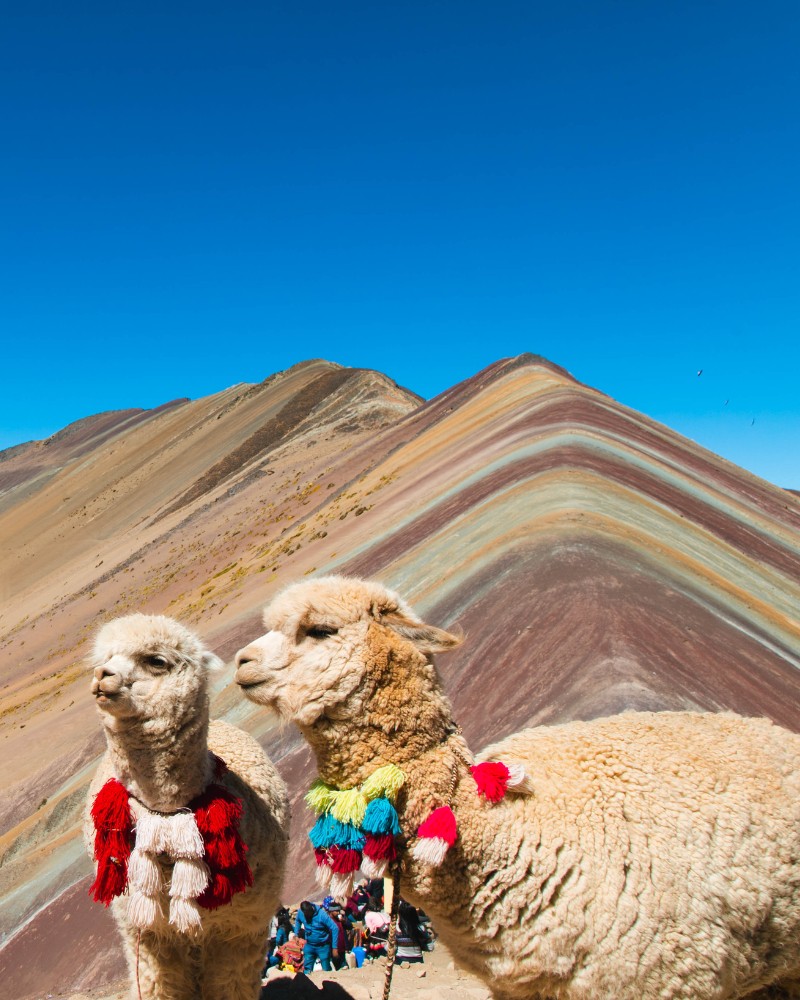
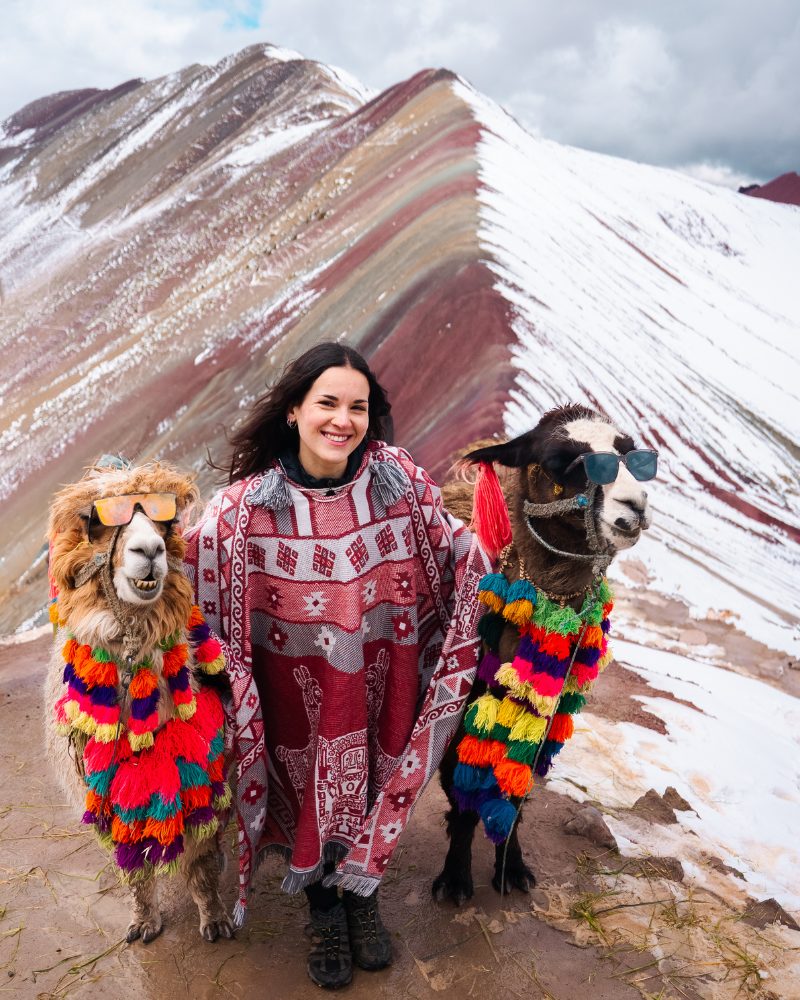
What should I bring to the mountains of colors?
Being properly prepared will make the difference between a comfortable experience and a difficult day in the mountains. The mountains of colors in Cusco are located at high altitudes, where the weather can change quickly and conditions are demanding.
Here is a list of the basic things you should keep in mind if you want to visit one of the four majestic colored mountains in Peru:
Clothing:
- Layers of clothing: Dress in layers to adapt to temperature changes. Start with light clothing at the beginning of the hike and bring warmer clothing for the summit, where the weather can be cold and windy.
- Waterproof jacket: Rain or snow can appear at any time in the mountains, so a waterproof jacket is crucial to keep you dry and comfortable.
- Hiking boots: No sandals! Leave those at the beach. In the mountains, proper footwear is essential to protect your feet and provide stability on uneven terrain. Choose sturdy, waterproof hiking boots that fit your feet well for comfort.
Accessories:
- Water bottle: Stay hydrated throughout your hike by bringing enough water. A reusable bottle is ideal for reducing your environmental impact.
- Sunscreen: The sun’s UV rays are more intense at high altitudes, so it’s important to protect your skin with SPF 50 or higher sunscreen.
- Sunglasses: Protect your eyes from the sun and wind with good quality sunglasses.
- Camera: Capture the breathtaking scenery and unforgettable moments of your adventure with your best camera.
- Toilet paper: An essential item that is often overlooked. Be sure to bring enough toilet paper for your personal use.
- Small backpack: Bring a small backpack to carry your essential belongings with you during the hike.
- Hat or cap: Protect your head from the sun and cold with a hat or cap.
- Gloves: Ideal for the coldest hours of the day, especially at the start of the hike.
- Hiking poles: Hiking poles can help you maintain balance, reduce stress on your joints, and improve your pace during the hike.
Others:
- Cash: There may not be ATMs in the area, so bring enough cash to cover your expenses.
- Snacks: Keep your energy levels up with light and nutritious snacks, such as dried fruit, energy bars, or nuts.
- Rain poncho: A lightweight and compact rain poncho will protect you from unexpected rain or snow.
- ID: Don’t forget to bring your ID for any eventuality.
Sustainable tip: Using filtered water bottles or even boiling water is a good way to reduce plastic use. In the next section, we’ll give you more recommendations for being a conscious and responsible tourist.

We are committed to sustainable tourism
As mentioned above, the rainbow mountains have gained popularity on social media, especially Vinicunca. The tourism boom, along with climate change, are factors that can contribute to the wear and tear of these natural areas. As visitors, there are actions and measures we can take to enjoy these monuments while causing as little damage as possible.
Discover how to be a responsible tourist!
- Stay on the trail: Staying on the designated trail prevents damage to larger areas and prevents trampling of native plants that are essential to the territory.
- Be considerate of animals: This area is home to llamas, alpacas, vicuñas, and other native species. Remember that we are in their natural habitat, so we should avoid invading their space or disturbing them.
- Respect the local population: The locals have lived in this area for generations and have always coexisted peacefully with the mountains. It is necessary to respect their traditions and customs, understanding that they are allowing us to visit their home.
- Do not generate waste: Avoid leaving trash or debris that could impact the environment. Everything you bring with you must return with you until you deposit it at an authorized point.
- Use filter bottles: This is a great way to reduce plastic consumption, as bottled water is often purchased. We recommend using filters, or boiling water and using canteens.
Remember that mountains suffer erosion with the constant flow of people walking. It’s essential to be careful and protect these lands to preserve the biodiversity of the area. That’s why it’s also good to keep in mind that there are alternatives to Vinicunca, such as Palccoyo or Pallay Punchu. Spreading tourism across various locations is beneficial to prevent overcrowding and its negative effects on the environment. We invite you to explore these wonderful sites that will enchant you and provide an unforgettable experience. If we all do our part, we can reduce our environmental impact. Join us for a more sustainable tourism!
Plan your adventure! Discover all the tours to explore
After learning about the differences between each mountain, we know that the next natural step is to choose how to live the experience.
That’s why Salkantay Trekking presents its best tours to the rainbow mountains of Cusco. These are not traditional rushed round-trip tours, but carefully designed experiences so you can make the most of each landscape.
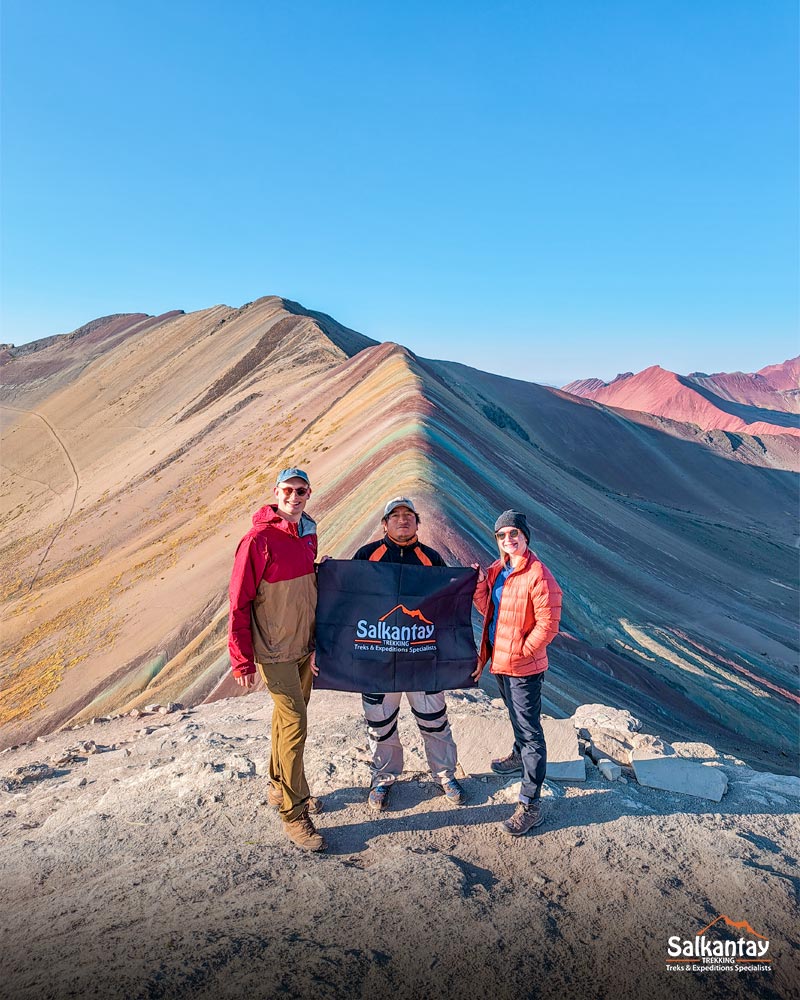
Vinicunca Rainbow Mountain and Red Valley Tour (2 days)
We chose this experience because it goes beyond the classic one-day tour. It is ideal for those who want to avoid the crowds, enjoy a sunrise in the mountains, and explore the impressive Red Valley at a more leisurely pace.
This tour combines nature, challenge, and an authentic connection with the Vilcanota mountain range.
What is the experience like?
On the first day, we leave early from Cusco for Pitumarca and continue on to Quesiuno, where we enjoy breakfast before starting the hike.
During the tour, we cross the Abra Puka (4,870 m/15,978 ft) and the Abra Warmisaya (4,985 m/16,355 ft), from where we have privileged views of Ausangate Snow-capped Mountain and Rainbow Mountain in the distance. The day ends with a night camping next to Surineqocha Lake under an impressive starry sky.
On the second day, we start early with the ascent to Vinicunca (5,100 m/16,732 ft). After enjoying the viewpoint and taking photographs, we descend to the Red Valley, one of the least visited and most impressive areas of the circuit.
Why do we recommend this tour?
On the first day, we leave early from Cusco for Pitumarca and continue on to Quesiuno, where we enjoy breakfast before starting the hike.
During the tour, we cross the Abra Puka (4,870 m/15,978 ft) and the Abra Warmisaya (4,985 m/16,355 ft), from where we have privileged views of Ausangate Snow-capped Mountain and Rainbow Mountain in the distance. The day ends with a night camping next to Surineqocha Lake under an impressive starry sky.
On the second day, we start early with the ascent to Vinicunca (5,100 m/16,732 ft). After enjoying the viewpoint and taking photographs, we descend to the Red Valley, one of the least visited and most impressive areas of the circuit.
Why do we recommend this tour?
- It allows you to avoid the busiest times.
- It includes the spectacular Red Valley.
- It offers a more profound and less rushed experience.
- It combines mountains, lagoons, and high-altitude camping.

Palcoyo Rainbow Mountain Tour
If you are looking for a less physically demanding alternative with fewer visitors, this tour is an excellent choice.
We include it among our best tours because it offers a broader panoramic experience: it is not just one mountain, but an entire mountain range of three rainbow mountains.
What is the experience like?
We leave early from Cusco to Cusipata for breakfast and then continue to Checacupe, where we visit its historic Inca, colonial, and republican bridges.
From the starting point, the hike is short and accessible. In approximately 50 minutes, you will reach the main viewpoint, from where you can see the three colored mountains, the stone forest, and the imposing Ausangate Snow-capped Mountain.
Why do we recommend this tour?
Ideal for travelers who prefer a more leisurely pace.
- Short and accessible hike.
- Less crowded than Vinicunca.
- Wide and photogenic landscape.
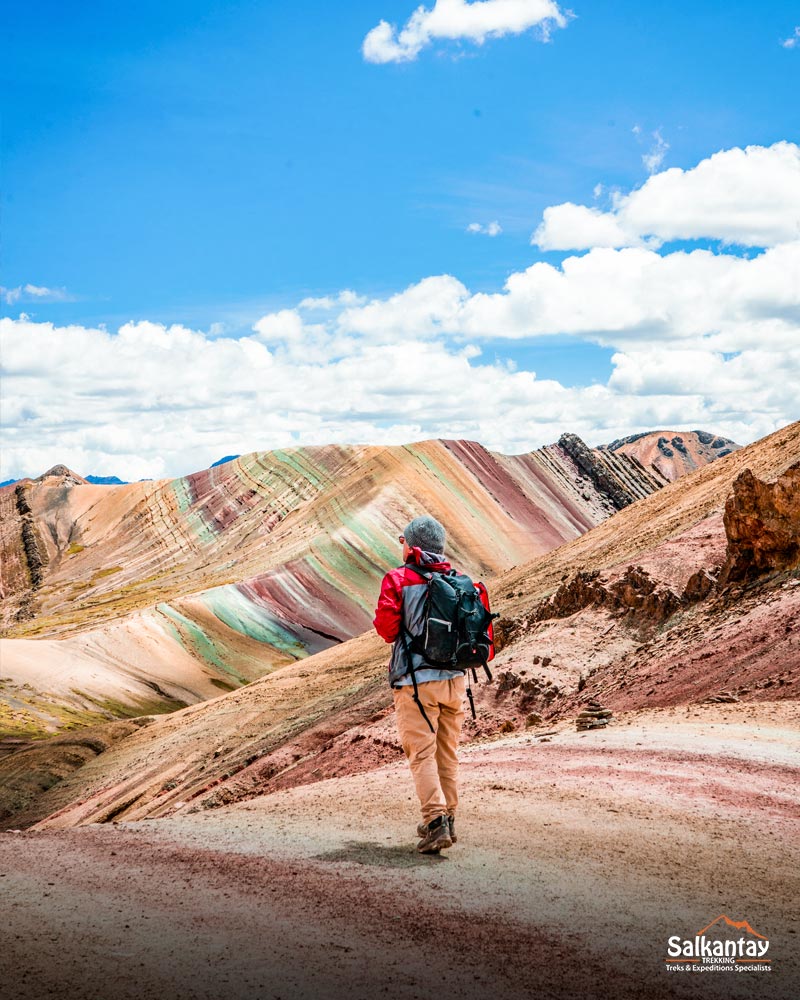

Pallay Punchu Tour
We selected this tour because it offers a completely different experience within the rainbow mountains of Cusco.
Pallay Punchu is not the most popular route, and that is precisely why it retains a more natural and less crowded environment.
What is the experience like?
We leave early from Cusco to Cusipata and then continue on to Sicuani, with views of the impressive Langui lagoon.
From Layo, we begin a hike of approximately two hours until we reach the sharp ridges of Pallay Punchu. Its unique geological formations and intense colors—reds, browns, yellows, greens, and magentas, create a landscape that seems like something from another planet.
From the top, you get a privileged view of Langui Lagoon and the Andean highlands.
Why do we recommend this tour?
- Fewer visitors.
- Rock formations with unique and well-defined shapes.
- Landscape next to a beautiful lagoon.
- A different experience from traditional mountain hiking.

Recommendations for the tour
All set to go! Before your visit to the Mountains of Colors in Peru, here are some important things to keep in mind and some practical tips to ensure a safe and enjoyable experience:
- Acclimatization to Altitude: Cusco and its surroundings are located at over 3,400 meters/11,154 feet. Proper acclimatization is crucial to avoid health problems during the hike.
- Appropriate Clothing: Bring warm and comfortable clothing, especially waterproof layers. Weather changes at high altitudes can be drastic, so be prepared for any eventuality.
- Sun Protection: The sun at high altitudes is intense. Don’t forget to bring sunscreen, a hat, and sunglasses to protect yourself during the hike and enjoy the scenery without any inconveniences.
- Water and Snacks: Bring enough water and energy-rich foods to stay hydrated and energized during the excursion. It is advisable to bring enough food, as it can be difficult to find options in the area.
- Cash: In some areas, there may be no access to ATMs. Therefore, be sure to bring enough cash to cover additional expenses such as entrance fees or local services.
These tips will help you make the most of your visit to the rainbow Mountains, whether you go to Vinicunca, Palcoyo, Pallay Punchu, or Wilcacunca. Get ready for an enriching experience that combines an impressive connection with nature and authentic Andean culture.
You may also be interested in:
- Palccoyo vs Pallay Punchu: The unknown rainbow mountains in Peru
- The Best Route to the Famous Rainbow Mountains of Peru
- Rainbow Mountain: Pallay Punchu, Everything You Need to Know
- Rainbow Mountain: Palccoyo, everything you need to know
- Rainbow Mountain, Vinicunca: Everything You Need to Know
- The History Behind the Rainbow Mountain in Peru (Vinicunca)
Written by: Hillary Cristina Quispe

Leave A Reply