
Meet Peru’s most famous animals: llamas, alpacas, vicuñas, and guanacos. If Cusco is your next travel destination, get ready to see them on some of Peru’s most famous routes.
These camelid species are native to South America and are mainly found in Peru, Bolivia, Chile, and Argentina. Accustomed to living at high altitudes, their home par excellence is the Andes mountain range. They are even known as protectors of the Apus, the sacred mountains of the area.
In this article, we will help you easily differentiate between them and also understand their cultural, economic, and tourist importance on popular routes such as the Vinicunca Rainbow Mountain.
We’ll help you tell them apart like an expert!
Table of contents
How many South American camelids are there?
There are four species of South American camelids: llama, alpaca, vicuña, and guanaco. Two of them are domesticated (llama and alpaca), while the other two live in the wild (vicuña and guanaco). All are perfectly adapted to the altitude and extreme climate of the Andes.
The Llama
Llamas have been inseparable companions of the Andean people for centuries. As far back as the Inca Empire, they were part of daily life, and even today, it’s common to see them wandering among the ruins of Machu Picchu.
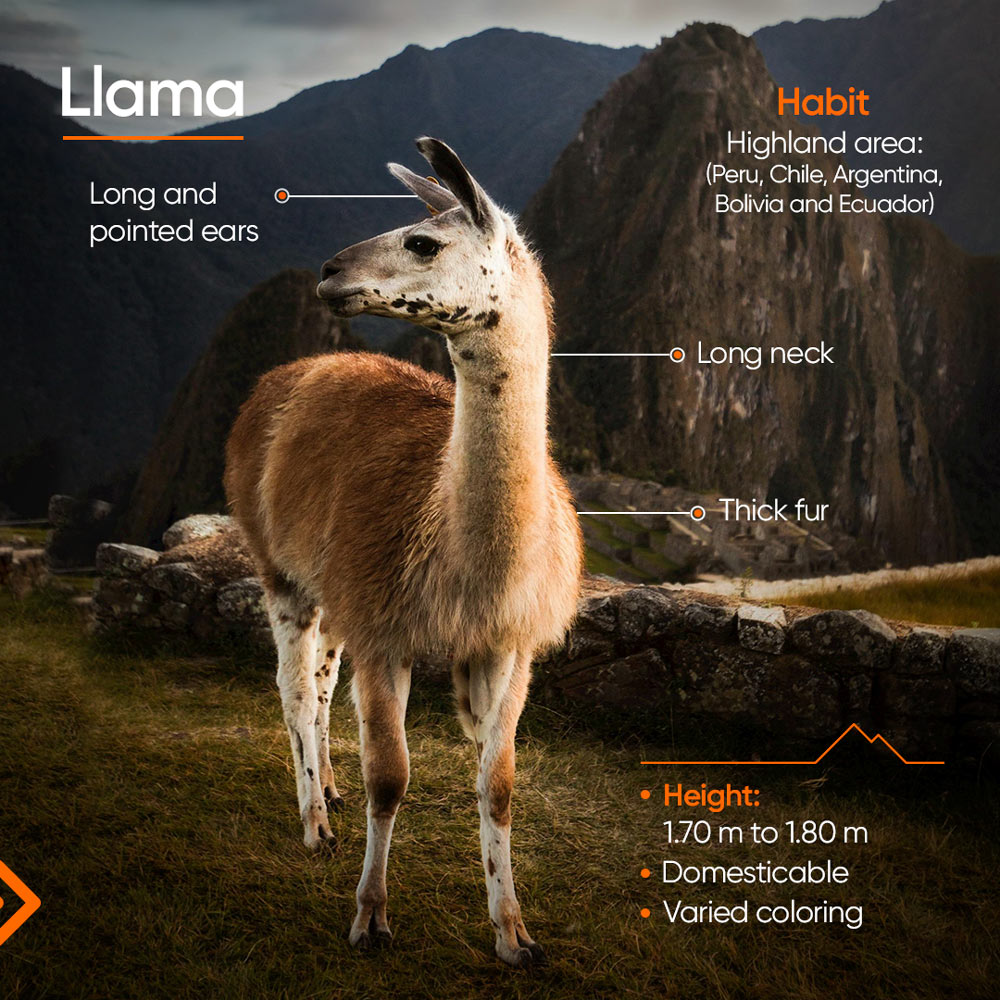
- Appearance: Llamas have a strong body and a long neck. They also have elongated faces and ears, which is a very distinctive trait and a key feature to differentiate them from alpacas. Their thick fur can vary in color or even combine several shades, including browns, whites, blacks, and grays.
- Size: Llamas are the largest of the domesticated camelids, standing about 1.7 to 1.8 meters tall (5.7 to 5.9 feet) and weighing between 115 and 180 kg (249 to 397 pounds).
- Use: In addition to being domesticated for carrying objects, llama wool is valued for its softness and durability. Its wool is used to make textiles and warm clothing.
- Fiber: Llama fiber is thicker and less soft than alpaca fiber, but it is still prized for its strength and durability.
- Behavior: Llamas are domesticated camelids primarily used as pack animals in the Andes Mountains of South America. They are known for being more independent.
Why Do Llamas Spit? You’ve probably seen those funny videos where a llama launches a surprise spit attack. But don’t be fooled—they don’t do it for fun! Spitting is their way of defending themselves when they feel uncomfortable, threatened, or like their space is being invaded. It’s a last resort for them, but if you bother them… get ready for the legendary llama spit! Always approach them with kindness and respect.
Fun fact! There are two types of llamas: Q’ara and Chaku. Although they are very similar, the Chaku llama has longer fur.

The Alpaca
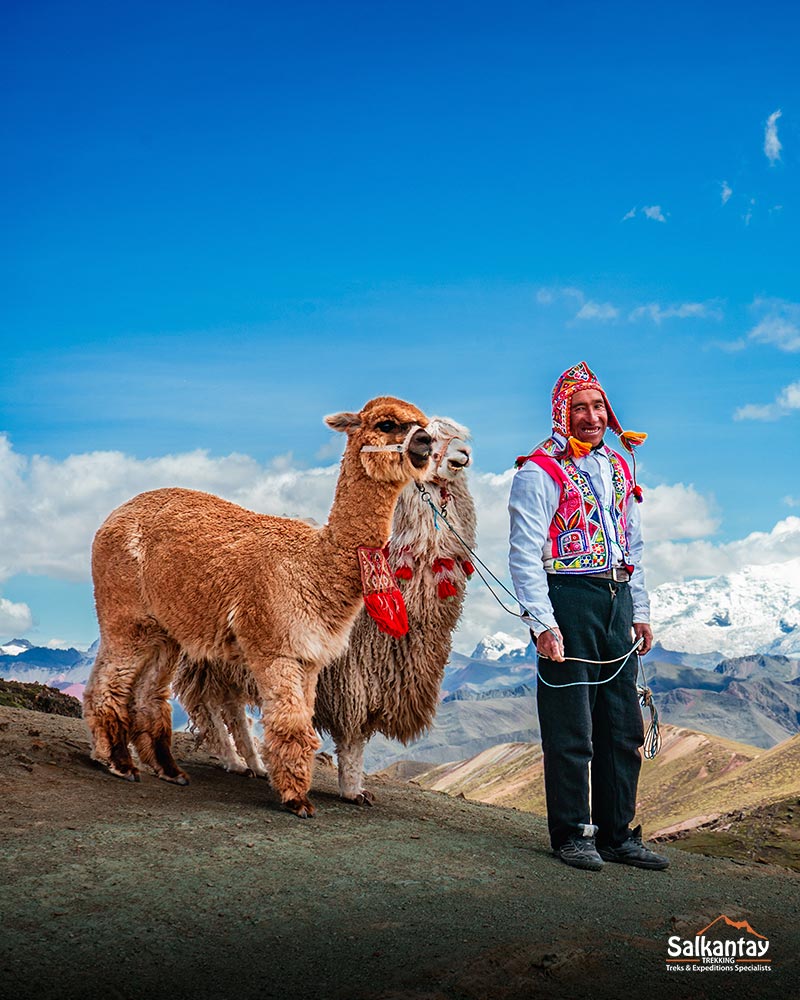
With their soft fur and gentle gaze, alpacas are one of the most representative animals of the Andes. It is common to see them in the surroundings of Cusco, especially on high-altitude routes such as Ausangate and the Mountain of Colors.

- Appearance: Alpacas have a more compact body and a small, round, and fluffy head, along with short, rounded ears. Their wool is curly, fluffy, and very soft. It comes in many colors, including white, black, brown, and shades of gray. Unlike llamas, alpacas usually have one solid color instead of a mix of tones.
- Size: Alpacas are smaller than llamas. They measure between 1.20 and 1.50 meters tall (3.9 to 4.9 feet) and weigh between 50 and 85 kilograms (110 to 187 pounds).
- Use: Alpacas are extremely important for the local economy, especially in rural areas. Their wool is considered one of the finest in the world. It’s used to make high-quality textiles like sweaters, scarves, blankets, and luxury clothing.
On the other hand, alpaca meat is a true delicacy. Rich in protein, low in fat, and with minimal cholesterol, it’s a healthy and highly valued option in Peruvian and Andean cuisine. - Fiber: Alpaca fiber is very soft, warm, and lightweight. The fiber comes in a variety of natural colors, similar to those found in autumn or wood. Alpaca wool is highly valued for its softness, warmth, and durability. Wool from young alpacas is the most sought after, known as “baby alpaca” or “royal alpaca.”
- Behavior: Alpacas are domesticated animals raised mainly for their high-quality wool. They are gentler than llamas and easier to manage, making them ideal to raise in larger groups.
Discover the hippie alpaca! There are also two types of alpacas: Huancayo and Suri. The Suri alpaca is characterized by its long, silky hair that falls in strands, like a fringe curtain. Its unique, bohemian style makes it look like it came straight out of an Andean festival. This Suri alpaca is less common. If you see one, you’re in luck!

The Vicuña
Unlike llamas and alpacas, vicuñas and guanacos are wild camelids and are currently protected by Peruvian law, which prohibits their hunting.
The vicuña, in particular, has special value in Peru. In addition to its legal protection, it appears on the national coat of arms as a symbol of the country’s fauna.

- Appearance: Vicuñas are the most delicate and elegant of the camelids, with a slender body and long legs. They have long, soft fur that is golden brown on the back and white on the belly and face.
- Size: Vicuñas are smaller than alpacas and llamas, standing about 1 to 1.20 meters tall (3.3 to 3.9 feet) and weighing between 35 and 55 kilograms (77 to 121 pounds).
- Use: Their main use is for producing high-end textiles. Vicuña wool is considered one of the finest fibers in the world, and products made from it can be extremely expensive.
- Fiber: Vicuña fiber is the finest in the world—extremely luxurious and pricey. Thanks to conservation efforts and strict laws, its collection is done sustainably and under control, only once a year.
- Behavior: Vicuñas are wild animals that typically live in high-altitude areas of the Andes. They are very agile and fast, which helps them escape predators—this also makes them harder to spot in the wild.


The Guanaco
The guanaco, a wild relative of the llama, is both agile and elegant. This animal is well adapted to mountainous landscapes and blends in perfectly with its surroundings. It can be spotted in the highest regions of Peru.

- Appearance: Guanacos are big animals, even bigger than llamas, with slender bodies and long legs. They have short, coarse fur that is light brown on the back and white on the belly.
- Size: The guanaco is the largest wild camelid in South America. They measure between 1.80 and 1.90 meters and weigh between 90 and 140 kilograms.
- Use: Historically, they were hunted for their meat and fur. Today, they are protected by law. Their fiber is used in rustic textiles, but production is limited and more expensive compared to other Andean animal wools.
- Fiber: Guanaco fiber is rougher than alpaca or vicuña wool, but it is still valued for its strength and long lifespan.
- Behavior: Guanacos are wild animals that live in various habitats across South America, including mountains, plains, and deserts. They are shy and usually avoid contact with humans.
Fun Fact! The guanaco is the ancestor of the llama, which was domesticated by the ancient peoples of the Andes. While the guanaco remains a wild animal, the llama was adapted to life in Andean communities, becoming a valuable companion in everyday activities.


Differences Between Llama, Alpaca, Vicuña and Guanaco
Here’s a table with the differences between llamas, alpacas, vicuñas, and guanacos, so you can easily distinguish them:
| Traits | Llama | Alpaca | Vicuña | Guanaco |
|---|---|---|---|---|
| Body | Large, with thick fur and different colors | Small, with curly, abundant fur of a single color | Stylized and cinnamon-colored with a white chest | Large, brown and white with a more arched neck |
| Face | Big and long | Chubby and furry, with round eyes | Small with a white nose. Pronounced eyes and eyelashes | Gray, large, and long |
| Ears | Long and pointed | Short and rounded | Small but pointed | Thin and erect |

Alpacas in Vinicunca and other routes
The Mountain of Colors (Vinicunca) is not only impressive for its colorful stripes (ochre, red, yellow, green, and purple), but also for the presence of Andean camelids, such as alpacas and llamas. It is common to see them grazing freely on the slopes of high areas such as Soraypampa or Abra Salkantay.
Accustomed to human presence, they beautify the environment and are the stars of photographs, offering the opportunity to capture incredible images with Vinicunca in the background, connecting visitors with traditional Andean life. It is even more common to encounter them on treks such as the Salkantay Trek and the Ausangate Trek, where communities use them to transport cargo, thus uniting nature, culture, and the mountains.
Unlike alpacas and llamas, it is very rare to see vicuñas or guanacos. These are wild camelids and much more shy, preferring to live in open areas away from tourist routes. Each encounter with the docile alpacas and llamas will remind you how Andean nature and culture merge in the high mountains of Peru.
Frequently asked questions about Andean camelids
Alpacas are frequently seen on Vinicunca Rainbow Mountain and on high-altitude trekking routes, such as Salkantay.
Day tours to Rainbow Mountain and multi-day treks in Cusco offer the best chance of seeing llamas and alpacas in their natural environment.
Yes, although it is less common. Vicuñas live in protected areas and in high Andean zones far from mass tourism.
Conclusion
Llamas, alpacas, vicuñas, and guanacos are vital to the Andean region of South America, being important not only to the economy but also as an essential part of the culture. Thanks to their domestication, a strong bond has been forged with the local communities of Cusco. This bond has been key to protecting and conserving these species, making them a fundamental part of Peruvian identity.
When you visit Cusco, you will have the unique opportunity to see these majestic animals. Encountering them will be a special moment, whether during a tour or on your day hikes in Cusco.
Book your adventure today and secure your place in one of Peru’s most impressive destinations.
You Might be Interested In:











Leave A Reply